Hoofdstuk 1Algebraïsch rekenen met
veeltermen
Leerplandoelstellingen (GO! Navigator)
Gevorderde wiskunde (WD3_06.08)
-
• WD3_06.08.18 (MD 06.08.13) De leerlingen lossen eenvoudige veeltermvergelijkingen, rationale vergelijkingen, irrationale vergelijkingen, exponentiële vergelijkingen, logaritmische vergelijkingen en goniometrische vergelijkingen algebraïsch op.
-
– afbakening: deling van veeltermen
-
– afbakening: deling door \((x-a)\)
-
Didactische uitwerking: veeltermen en hun graad, getalwaarde en nulwaarden, het schema van Horner, gelijke veeltermen, de euclidische deling, de reststelling, deelbaarheid door \(x-a\) en door \((x-a)(x-b)\), veeltermen van de vorm \(x^n\pm a^n\) en ontbinden in factoren.
I De euclidische deling
1 De veeltermen \(\R [x]\)
veelterm: som van eentermen
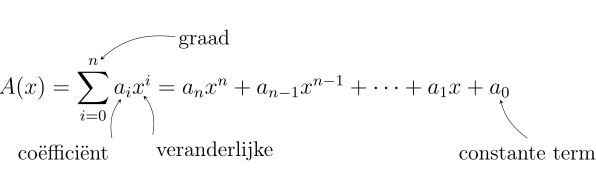
-
• \(\R [x]\): verzameling veeltermen
-
• graad: hoogste voorkomende exponent; notatie \(\gr \bigl (A(x)\bigr )\)
-
• Opmerking: de nulveelterm \(0\) heeft geen graad.
-
• getalwaarde: invullen; notatie \(A(a)\)
Voorbeeld
\(\seteqnumber{0}{}{0}\)\begin{align*} A(x) &= 2x^3 - 4x + 3 \\ A(2) &= 2\cdot 2^3 - 4\cdot 2 + 3 = 11 \end{align*}
Nulwaarde
\(a\) is een nulwaarde van \(A(x)\) \(\iff A(a) = 0\)
\(\seteqnumber{0}{}{0}\)\begin{align*} A(x) &= 2x - 4 &&\Rightarrow \quad \text {nulwaarde van } A\text {: } 2 \quad \text {want } A(2) = 0 \\ B(x) &= x^2 - 2x - 8 &&\Rightarrow \quad \text {nulwaarden van } B\text {: } 4 \text { en } {-2} \end{align*}
Voorbeeld met GRM
\(B(x) = x^2 - 2x - 8\): de getalwaarde \(B(3)\) en de nulwaarden.
statplotf1y= en voer het voorschrift in.
Bij \(Y_1\) komt het voorschrift van \(B\), met \(X\) in de plaats van \(x\). De \(X\) typ je met linkX,T,θ,n, het kwadraat met πH^.
Getalwaarde:
2ndquitmode, dan A-lockalphacalcf4trace 1:Y1, typ (3) en entrysolveenter.
In het rekenscherm vragen we de getalwaarde van \(Y_1\) in \(3\) \(\Rightarrow \) \(B(3) = -5\). Het kan ook langs distrvars Y-VARS 1:Function 1:Y1.
Of in de grafiek: 2ndcalcf4trace 1:value, typ \(3\) en entrysolveenter.
Onderaan lees je de coördinaten van het punt op de grafiek af \(\Rightarrow \) \(B(3) = -5\).
Nulwaarden:
2ndcalcf4trace 2:zero tussen \(-5\) en \(0\).
Een nulwaarde van \(B\) is een snijpunt van de grafiek met de \(x\)-as. Het GRM vraagt Left Bound?, Right Bound? en Guess?. Typ een grens links en een grens rechts van het snijpunt, telkens met entrysolveenter, en nog eens entrysolveenter bij Guess? \(\Rightarrow \) nulwaarde \(-2\).
2ndcalcf4trace 2:zero tussen \(2\) en \(7\).
\(\Rightarrow \) nulwaarde \(4\)
VBTL Oefeningen
VBTL Analyse 1a: p 16 nr 1
2 Algoritme van Horner
algoritme: herhalend stappenplan
-
• berekenen van een getalwaarde
-
• berekenen van het quotiënt bij een opgaande deling (rest \(0\) \(\iff \) nulwaarde)
-
• vooraf: veelterm rangschikken en volledig maken
Voorbeeld 1
\(A(x) = 2x^3 - 4x + 3\), \(A(2) = ?\)
\[ \begin {array}{r|rrr|r} & 2 & 0 & -4 & 3 \\ 2 & \downarrow & 4 & 8 & 8 \\ \hline & 2 & 4 & 4 & 11 \end {array} \qquad \begin {array}{l}
\leftarrow \text {coëfficiënten van } A(x) \\ \\ \leftarrow \text {coëfficiënten quotiënt}\ \big |\ \text {getalwaarde = rest} \end {array} \]
\[ \Rightarrow \quad A(2) = 11 \]
Voorbeeld 2
\(A(x) = 6x^3 - 2x^2 + x - 5\)
\(1\) is een nulwaarde (op zicht: \(6 - 2 + 1 - 5 = 0\)).
\[ \begin {array}{r|rrr|r} & 6 & -2 & 1 & -5 \\ 1 & \downarrow & 6 & 4 & 5 \\ \hline & 6 & 4 & 5 & 0 \end {array} \]
\(\seteqnumber{0}{}{0}\)\begin{align*} \Rightarrow \quad 6x^3 - 2x^2 + x - 5 &= (x-1)(6x^2 + 4x + 5) \\ D &= 16 - 4\cdot 6\cdot 5 < 0 \end{align*}
VBTL Oefeningen
VBTL Analyse 1a: p 16 nr 2 en 3
3 Gelijke veeltermen
veeltermen zijn gelijk
\[ \iff \begin {cases} \text {hun graad is gelijk} \\ \text {hun overeenkomstige coëfficiënten zijn gelijk} \end {cases} \]
Voorbeeld
\[ ax^3 - 4x^2 + bx + 2 = cx^4 + 5x^3 - dx^2 + 2ax - e \]
\[ \iff \begin {cases} a = 5 \\ b = 2a \\ c = 0 \\ d = 4 \\ -e = 2 \end {cases} \iff \begin {cases} a = 5 \\ b = 10 \\ c = 0 \\ d = 4 \\ e = -2 \end {cases} \]
VBTL Oefeningen
VBTL Analyse 1a: p 16 nr 4 en 6
4 Bewerkingen met veeltermen
Lees handboek VBTL Analyse 1a, p 12.
\(A(x), B(x) \in \R [x]\), \(k \in \R \), \(n \in \N \)
\begin{align*}
\Rightarrow \quad & A(x) + B(x) \in \R [x] \\ & A(x)\cdot B(x) \in \R [x] \\ & k\,A(x) \in \R [x] \\ & \bigl (A(x)\bigr )^n \in \R [x] \\ & \frac {A(x)}{B(x)} \text { met }
B(x) \neq 0\text {: niet altijd een veelterm (zie onder)}
\end{align*}
Opmerkingen
-
• \(\gr \bigl (A(x) + B(x)\bigr ) \leq \max \Bigl (\gr \bigl (A(x)\bigr ), \gr \bigl (B(x)\bigr )\Bigr )\) (als \(A(x) + B(x) \neq 0\))
-
• Als \(A(x)\cdot B(x) \neq 0\), dan \(\gr \bigl (A(x)\cdot B(x)\bigr ) = \gr \bigl (A(x)\bigr ) + \gr \bigl (B(x)\bigr )\).
-
• Als \(B(x)\) een eenterm is en \(\gr \bigl (B(x)\bigr ) \leq \) laagst voorkomende graad in \(A(x)\), dan
\[ \gr \left (\frac {A(x)}{B(x)}\right ) = \gr \bigl (A(x)\bigr ) - \gr \bigl (B(x)\bigr ). \]
VBTL Oefeningen
VBTL Analyse 1a: p 16 nr 5
5 Euclidische deling
Deling in \(\N \)
\(\forall a \in \N ,\ \forall d \in \N _0 : \exists \, q, r \in \N :\)
\[ \underset {\substack {\uparrow \\\text {deeltal}}}{a} = \underset {\substack {\uparrow \\\text {deler}}}{d}\cdot \underset {\substack {\uparrow \\\text {quotiënt}}}{q} + \underset {\substack {\uparrow \\\text {rest}}}{r} \qquad \text {met } 0 \leq r < d \]
\(\seteqnumber{0}{}{0}\)\begin{align*} \frac {7}{2} &= 3.5 &&\Rightarrow \quad 7 = 2\cdot 3 + 1 \\ \frac {1254}{23} &= ? \end{align*}
\[ \begin {array}{r|l} 1254 & 23 \\ \cline {2-2} -115\phantom {4} & 54 \\ \cline {1-1} 104 & \\ -92 & \\ \cline {1-1} 12 & \end {array} \qquad \Rightarrow \quad 1254 = 23\cdot 54 + 12 \]
Analoog in \(\R [x]\)
\[ \frac {x^2 + 7x + 8}{x + 1} = ? \]
\[ \underbrace {x^2 + 7x + 8}_{\text {deeltal}} = \underbrace {(x + 1)}_{\text {deler}}\,\underbrace {(x + 6)}_{\text {quotiënt}} + \underbrace {2}_{\text {rest}} \]
\[ A(x) = D(x)\cdot Q(x) + R(x) \]
Definitie
Euclidische deling van \(A(x)\) door \(D(x)\):
\[ A(x) = D(x)\cdot Q(x) + R(x) \qquad \text {met } \gr \bigl (R(x)\bigr ) < \gr \bigl (D(x)\bigr ) \text { of } R(x) = 0 \]
-
• \(A(x)\): deeltal
-
• \(D(x)\): deler
-
• \(Q(x)\): quotiënt
-
• \(R(x)\): rest
Opmerkingen
-
• \(R(x) = 0 \Rightarrow \) opgaande deling
-
• \(R(x) \neq 0 \Rightarrow \) niet-opgaande deling
-
• Als \(\gr \bigl (A(x)\bigr ) < \gr \bigl (D(x)\bigr )\), dan \(Q(x) = 0\) en \(R(x) = A(x)\).
Bewijs
\(\gr A < \gr D\)
\(\seteqnumber{0}{}{0}\)\begin{align*} \Rightarrow \qquad A(x) &= D(x)\cdot Q(x) + R(x) \\ &\Rightarrow \qquad Q(x) = 0 \qquad \bigl (\text {anders } \gr (D\cdot Q + R) \geq \gr D > \gr A\ \lightning \bigr ) \\ &\Rightarrow \qquad A(x) = D(x)\cdot 0 + R(x) \\ &\iff \qquad A(x) = R(x) \qed \end{align*}
6 Algoritme van de euclidische deling
Voorbeeld
\(A(x) = 2x^4 - 9x^2 - x - 4\), \(D(x) = -2x^2 + 4x - 3\)
\[ \begin {array}{rrrrrr|l} & 2x^4 & +0x^3 & -9x^2 & -x & -4 & -2x^2+4x-3 \\ \cline {7-7} - & 2x^4 & -4x^3 & +3x^2 & & & -x^2-2x+2 \\ \cline
{2-4} & & 4x^3 & -12x^2 & -x & -4 & \\ - & & 4x^3 & -8x^2 & +6x & & \\ \cline {3-5} & & & -4x^2 & -7x & -4 & \\ - &
& & -4x^2 & +8x & -6 & \\ \cline {4-6} & & & & -15x & +2 & \end {array} \]
\[ \Rightarrow \quad \underbrace {2x^4 - 9x^2 - x - 4}_{A} = \underbrace {(-2x^2 + 4x - 3)}_{D}\,\underbrace {(-x^2 - 2x + 2)}_{Q} \underbrace {-\,15x + 2}_{R} \]
Algoritme
-
1. rangschikken, vervolledigen
-
2. hoogstegraadsterm \(A\) \(/\) hoogstegraadsterm \(D\)
-
3. bekomen term in \(Q\) \(\times \) \(D\)
-
4. partiële rest \(=\) aftrekken
Herhaal stap 2 tot 4 tot \(\gr R < \gr D\) of \(R = 0\).
VBTL Oefeningen
VBTL Analyse 1a: p 17 nr 7 tot 11
7 Quotiënt en rest bestaan en zijn enig
Stelling
Bij de euclidische deling bestaan het quotiënt en de rest, en zijn ze enig.
Bewijs
Bestaan: uit het algoritme volgt dat \(Q(x)\) en \(R(x)\) bestaan.
Enig: bewijs uit het ongerijmde.
Veronderstel: niet enig, dus naast \(Q(x)\) en \(R(x)\) bestaan er nog \(Q'(x)\) en \(R'(x)\) zodat \(Q(x) \neq Q'(x)\)
\(\seteqnumber{0}{}{0}\)\begin{align*} \Rightarrow \qquad A(x) &\overset {(1)}{=} D(x)\,Q(x) + R(x) &&\text {met } \gr R(x) \overset {(3)}{<} \gr D(x) \text { of } R(x) = 0 \\ A(x) &\overset {(2)}{=} D(x)\,Q'(x) + R'(x) &&\text {met } \gr R'(x) \overset {(4)}{<} \gr D(x) \text { of } R'(x) = 0 \end{align*}
\(\seteqnumber{0}{}{0}\)\begin{align*} \overset {(1)\text { en }(2)}{\Rightarrow }\qquad D(x)\,Q(x) + R(x) &= D(x)\,Q'(x) + R'(x) \\ \iff \qquad R(x) - R'(x) &\overset {(5)}{=} D(x)\bigl (Q'(x) - Q(x)\bigr ) \end{align*}
Twee gevallen: \(R(x)\) en \(R'(x)\) niet beide \(0\), of \(R(x) = R'(x) = 0\).
Geval 1: \(R(x)\) en \(R'(x)\) niet beide \(0\)
\(\seteqnumber{0}{}{0}\)\begin{align*} \overset {(3)\text { en }(4)}{\Rightarrow }\qquad & \gr \bigl (R(x) - R'(x)\bigr ) \leq \max \bigl (\gr R(x), \gr R'(x)\bigr ) < \gr D(x) \\ \iff \qquad & \gr \bigl (R(x) - R'(x)\bigr ) < \gr D(x) \\ \overset {(5)}{\iff }\qquad & \gr \Bigl (D(x)\bigl (Q'(x) - Q(x)\bigr )\Bigr ) < \gr D(x) \\ \iff \qquad & \gr D(x) + \gr \bigl (Q'(x) - Q(x)\bigr ) < \gr D(x) \\ \iff \qquad & \gr \bigl (Q'(x) - Q(x)\bigr ) < 0 \quad \lightning \quad \text {een veelterm kan geen negatieve graad hebben} \\ \Rightarrow \qquad & \text {veronderstelling } Q'(x) \neq Q(x) \text { is vals} \\ \Rightarrow \qquad & Q'(x) = Q(x) \text { en dus ook } R'(x) = R(x) \quad \text {(uit (1) en (2))} \end{align*}
Geval 2: \(R(x) = R'(x) = 0\)
\(\seteqnumber{0}{}{0}\)\begin{align*} \overset {(5)}{\Rightarrow }\qquad & 0 = D(x)\cdot \bigl (Q'(x) - Q(x)\bigr ) \qquad \text {($D(x)$ is deler $\Rightarrow D(x) \neq 0$)} \\ \iff \qquad & Q'(x) - Q(x) = 0 \\ \iff \qquad & Q'(x) = Q(x) \qed \end{align*}
VBTL Oefeningen
VBTL Analyse 1a: p 17 nr 12; p 18 nr 13 tot 16
II Deelbaarheid in \(\R [x]\)
1 Definitie
\(A(x)\) is deelbaar door \(D(x)\) \(\iff \) de rest van de euclidische deling is nul.
Notatie: \(D(x) \mid A(x)\) (\(D\) deelt \(A\))
In symbolen:
\[ D(x) \mid A(x) \iff A(x) = D(x)\cdot Q(x) \text { met } R(x) = 0 \]
Opmerking: \(D(x) \nmid A(x)\) (\(D\) deelt \(A\) niet) \(\Rightarrow R(x) \neq 0\)
Voorbeelden
\(2x + 3 \mid 2x^3 + 5x^2 + 5x + 3\)
\(Q(x) = x^2 + x + 1\), \(R(x) = 0\)
\[ \begin {array}{rrrrr|l} & 2x^3 & +5x^2 & +5x & +3 & 2x+3 \\ \cline {6-6} - & 2x^3 & +3x^2 & & & x^2+x+1 \\ \cline {2-3} & & 2x^2 & +5x & +3 & \\ - & & 2x^2 & +3x & & \\ \cline {3-4} & & & 2x & +3 & \\ - & & & 2x & +3 & \\ \cline {4-5} & & & & 0 & \end {array} \qquad \Rightarrow \quad R(x) = 0 \]
\(2x + 2 \nmid 6x^3 + 8x^2 + 4x + 20\)
\(Q(x) = 3x^2 + x + 1\), \(R(x) = 18\)
\[ \begin {array}{rrrrr|l} & 6x^3 & +8x^2 & +4x & +20 & 2x+2 \\ \cline {6-6} - & 6x^3 & +6x^2 & & & 3x^2+x+1 \\ \cline {2-3} & & 2x^2 & +4x & +20 & \\ - & & 2x^2 & +2x & & \\ \cline {3-4} & & & 2x & +20 & \\ - & & & 2x & +2 & \\ \cline {4-5} & & & & 18 & \end {array} \qquad \Rightarrow \quad R(x) = 18 \neq 0 \]
2 Reststelling bij deling door \(x - a\)
Stelling
Veelterm \(A(x)\) delen door \(D(x) = x - a\) (\(a \in \R \))
\[ \Rightarrow \quad \underbrace {\text {rest } R(x) \text { gelijk aan getalwaarde } A(a)} \]
Bewijs
Te bewijzen: \(R(x) = A(a)\)
\(\seteqnumber{0}{}{0}\)\begin{align*} A(x) &= D(x)\cdot Q(x) + R(x) &&\text {met } \gr R < \gr D \text { of } R = 0 \\ \iff \qquad A(x) &= \underbrace {(x - a)}_{\gr D = 1}\cdot Q(x) + R(x) &&\Rightarrow \ \gr R = 0 \text { of } R = 0 \\ & &&\text {dus } R \text { is een constante } r \\ \overset {x = a}{\Rightarrow }\qquad A(a) &= (a - a)\cdot Q(a) + r &&\text {($a$ invullen links en rechts)} \\ \iff \qquad A(a) &= 0\cdot Q(a) + r \\ \iff \qquad A(a) &= r \qed \end{align*}
Voorbeeld
\(A(x) = 2x^3 + 9x^2 + 8x + 1\), \(D(x) = x + 3\)
-
• invullen: \(A(-3) = \cdots = 4\)
\[ A(-3) = 2(-3)^3 + 9(-3)^2 + 8(-3) + 1 = -54 + 81 - 24 + 1 = 4 \]
-
• Horner:
\[ \begin {array}{r|rrr|r} & 2 & 9 & 8 & 1 \\ -3 & \downarrow & -6 & -9 & 3 \\ \hline & 2 & 3 & -1 & 4 \end {array} \qquad \Rightarrow \quad R(x) = A(-3) = 4 \]
3 Quotiënt bij deling door \(x - a\)
Eigenschap
Als de deler van de vorm \(D(x) = x - a\) is, dan zijn de coëfficiënten van \(Q(x)\) af te lezen in het schema van Horner.
Voorbeeld
\(2x^3 + 9x^2 + 8x + 1\) delen door \(x + 3\)
\(Q(x) = 2x^2 + 3x - 1\), \(R(x) = 4\)
\[ \begin {array}{rrrrr|l} & 2x^3 & +9x^2 & +8x & +1 & x+3 \\ \cline {6-6} - & 2x^3 & +6x^2 & & & 2x^2+3x-1 \\ \cline {2-3} & & 3x^2 & +8x & +1 & \\ - & & 3x^2 & +9x & & \\ \cline {3-4} & & & -x & +1 & \\ - & & & -x & -3 & \\ \cline {4-5} & & & & 4 & \end {array} \qquad \begin {array}{r|rrr|r} & 2 & 9 & 8 & 1 \\ -3 & \downarrow & -6 & -9 & 3 \\ \hline & 2 & 3 & -1 & 4 \end {array} \]
\[ \Rightarrow \quad 2x^3 + 9x^2 + 8x + 1 = (x + 3)(2x^2 + 3x - 1) + 4 \]
VBTL Oefeningen
VBTL Analyse 1a: p 29 nr 1
4 Kenmerk van deelbaarheid door \(x - a\)
Stelling
\[ \underbrace {A(x) \text { deelbaar door } x - a} \iff A(a) = 0 \]
Bewijs
\(x - a \mid A(x)\)
\(\seteqnumber{0}{}{0}\)\begin{align*} \iff \qquad & \text {rest bij deling is } 0 \quad (\Rightarrow R(x) = 0) \\ \iff \qquad & A(a) = 0 \qquad \text {want } A(a) = R(x) \qed \end{align*}
Voorbeelden
\(x - 2 \mid A(x) = 3x^2 - 4x - 4\)
\[ A(2) = 3\cdot 2^2 - 4\cdot 2 - 4 = 0 \]
\(x + 3 \nmid B(x) = x^3 - 2x^2 + x - 1\)
\[ B(-3) = (-3)^3 - 2(-3)^2 + (-3) - 1 = -27 - 18 - 3 - 1 = -49 \neq 0 \]
5 Bepalen van de delers van de vorm \(x - a\)
Stelling
Voor gehele coëfficiënten \(a_i\) en \(a \in \Z \):
\(\seteqnumber{0}{}{0}\)\begin{align*} & x - a \mid a_nx^n + a_{n-1}x^{n-1} + \cdots + a_1x + a_0 \\ \Rightarrow \qquad & a \mid a_0 \end{align*} (Is \(A(x)\) deelbaar door \(x - a\), dan is de constante term deelbaar door \(a\).)
Bewijs
\(x - a \mid a_nx^n + a_{n-1}x^{n-1} + \cdots + a_1x + a_0\)
\(\seteqnumber{0}{}{0}\)\begin{align*} \overset {A(a) = 0}{\Rightarrow }\qquad & a_na^n + a_{n-1}a^{n-1} + \cdots + a_1a + a_0 = 0 \\ \iff \qquad & a\,(a_na^{n-1} + a_{n-1}a^{n-2} + \cdots + a_1) + a_0 = 0 \\ \iff \qquad & a\,(a_na^{n-1} + a_{n-1}a^{n-2} + \cdots + a_1) = -a_0 \\ \iff \qquad & \underbrace {a}_{\text {getal}}\cdot \underbrace {(-a_na^{n-1} - a_{n-1}a^{n-2} - \cdots - a_1)}_{\text {geheel getal}} = \underbrace {a_0}_{\text {getal}} \\ \Rightarrow \qquad & a \mid a_0 \qed \end{align*}
Opmerking
Bewijs maar in één richting! \(x - a \mid A(x)\): nodig dat \(a \mid a_0\), maar niet voldoende.
Voorbeelden
-
• \(x - 2 \nmid x^2 - 3x + 4\) want \(A(2) = 2 \neq 0\), en toch \(2 \mid 4\)
-
• \(x + 3\) kan \(x^2 - 3x + 4\) niet delen want \(-3 \nmid 4\)
Praktisch
Werkwijze om delers van de vorm \((x - a)\) te zoeken (met \(a \in \Z \)):
-
1. bepaal de delers van de constante term
-
2. bepaal de getalwaarde voor die delers
Voorbeeld
\(A(x) = x^3 + 3x^2 - x - 3\)
delers \(x - 1\), \(x + 1\) en \(x + 3\) delers van \(-3\): \(1\), \(-1\), \(3\), \(-3\)
\(\seteqnumber{0}{}{0}\)\begin{align*} A(1) &= 1 + 3 - 1 - 3 = 0 &&\Rightarrow \quad x - 1 \mid A(x) \\ A(-1) &= -1 + 3 + 1 - 3 = 0 &&\Rightarrow \quad x + 1 \mid A(x) \\ A(3) &= 27 + 27 - 3 - 3 = 48 \neq 0 &&\Rightarrow \quad x - 3 \nmid A(x) \\ A(-3) &= -27 + 27 + 3 - 3 = 0 &&\Rightarrow \quad x + 3 \mid A(x) \end{align*}
Voorbeeld met GRM
\(A(x) = x^3 + 3x^2 - x - 3\): de delers van de vorm \(x - a\).
statplotf1y= en voer het voorschrift in.
De delers van de constante term \(-3\) zijn \(1\), \(-1\), \(3\) en \(-3\). Voor elk van die getallen zoeken we de getalwaarde.
Met een tabel:
2ndtblsetf2window en laat de tabel beginnen bij \(-3\).
TblStart is de eerste waarde van \(X\) in de tabel: de kleinste deler van de constante term. Met ΔTbl=1 gaat de tabel telkens \(1\) verder.
2ndtablef5graph: de getalwaarden staan onder elkaar.
Een \(0\) in de kolom van \(Y_1\) is een nulwaarde: \(A(-3) = A(-1) = A(1) = 0\) \(\Rightarrow \) delers \(x + 3\), \(x + 1\) en \(x - 1\). Met ▼ blader je verder tot \(X = 3\): \(A(3) = 48 \neq 0\).
Met een lijst:
2ndquitmode, dan A-lockalphacalcf4trace 1:Y1 en typ tussen de haakjes de delers van de constante term als lijst.
De accolades typ je met 2nd{K( en 2nd}L). Het GRM geeft de getalwaarden in dezelfde volgorde: \(A(1) = 0\), \(A(-1) = 0\), \(A(3) = 48\) en \(A(-3) = 0\).
VBTL Oefeningen
VBTL Analyse 1a: p 29 nr 2 en 3
6 Kenmerk van deelbaarheid door \((x - a)(x - b)\)
Eigenschap
\(\forall a, b \in \R ,\ A(x) \in \R [x]\):
\(\seteqnumber{0}{}{0}\)\begin{align*} & (x - a)(x - b) \mid A(x) \\ \Rightarrow \qquad & x - a \mid A(x) \ \wedge \ x - b \mid A(x) \end{align*}
Bewijs
\((x - a)(x - b) \mid A(x)\)
\(\seteqnumber{0}{}{0}\)\begin{align*} \overset {\text {def deelbaar}}{\iff }\qquad & A(x) = (x - a)(x - b)\cdot Q(x) \quad \text {voor zekere } Q(x) \\ \overset {\substack {\text {associatief}\\\text {en commutatief}}}{\Rightarrow }\qquad & A(x) = \underbrace {(x - a)}_{\text {deler}} \underbrace {\bigl ((x - b)\cdot Q(x)\bigr )}_{\text {quotiënt}} \\ & \text {en } A(x) = (x - b)\bigl ((x - a)\,Q(x)\bigr ) \\ \overset {\text {def deelbaar}}{\Rightarrow }\qquad & x - a \mid A(x) \ \wedge \ x - b \mid A(x) \qed \end{align*}
Omgekeerd
\(\forall a, b \in \R \) met \(a \neq b\), \(A(x) \in \R [x]\):
\(\seteqnumber{0}{}{0}\)\begin{align*} & x - a \mid A(x) \ \wedge \ x - b \mid A(x) \\ \Rightarrow \qquad & (x - a)(x - b) \mid A(x) \end{align*}
Bewijs
\(\seteqnumber{0}{}{0}\)\begin{align*} x - a \mid A(x) &\quad \Rightarrow \quad A(x) = (x - a)\cdot Q(x) \tag {1} \\ x - b \mid A(x) &\quad \Rightarrow \quad A(b) = 0 \tag {2} \end{align*}
\(\seteqnumber{0}{}{0}\)\begin{align*} \overset {(1)\text { en }(2)}{\Rightarrow }\qquad & \underbrace {A(b)}_{=\,0} = \underbrace {(b - a)}_{\neq \,0}\cdot Q(b) \\ \Rightarrow \qquad & Q(b) = 0 \\ \Rightarrow \qquad & Q(x) = (x - b)\cdot Q'(x) \\ \overset {(1)}{\Rightarrow }\qquad & A(x) = (x - a)(x - b)\cdot Q'(x) \\ \Rightarrow \qquad & (x - a)(x - b) \mid A(x) \qed \end{align*}
Besluit
\(\forall a, b \in \R ,\ a \neq b,\ A(x) \in \R [x]\):
\[ \left . \begin {array}{l} x - a \mid A(x) \\ x - b \mid A(x) \end {array} \right \} \iff (x - a)(x - b) \mid A(x) \]
Uitbreiding
\[ (x - a)(x - b)(x - c)\cdots \mid A(x) \iff \begin {cases} x - a \mid A(x) \\ x - b \mid A(x) \\ x - c \mid A(x) \\ \quad \vdots \end {cases} \]
met \(a\), \(b\), \(c\), … verschillend.
Voorbeeld
\(A(x) = 3x^5 + 6x^4 - 2x^3 - 4x^2 - x - 2\)
delers van \(-2\): \(1\), \(-1\), \(2\), \(-2\)
\[ \left . \begin {array}{l} A(1) = 0 \\ A(-1) = 0 \\ A(2) \neq 0 \\ A(-2) = 0 \end {array} \right \} \Rightarrow \quad A(x) = (x - 1)(x + 1)(x + 2)\, \underbrace {(\phantom {3x^2 + 1})}_{\substack {\text {quotiënt}\\\text {van graad } 2}} \]
\[ \begin {array}{r|rrrrrr} & 3 & 6 & -2 & -4 & -1 & -2 \\ 1 & \downarrow & 3 & 9 & 7 & 3 & 2 \\ \hline & 3 & 9 & 7 & 3 & 2
& \boxed {0} \\ -1 & \downarrow & -3 & -6 & -1 & -2 & \\ \hline & 3 & 6 & 1 & 2 & \boxed {0} & \\ -2 & \downarrow & -6 & 0 &
-2 & & \\ \hline & 3 & 0 & 1 & \boxed {0} & & \end {array} \]
\[ \Rightarrow \quad A(x) = (x - 1)(x + 1)(x + 2)(3x^2 + 1) \]
Opmerking
Een veelterm van de \(n\)-de graad heeft hoogstens \(n\) verschillende nulwaarden.
Gevolg
Een veelterm van graad \(n\) met \(n\) verschillende nulwaarden \(\alpha _1, \alpha _2, \ldots , \alpha _n\) is te schrijven als
\[ a_nx^n + a_{n-1}x^{n-1} + \cdots + a_0 = a_n(x - \alpha _1)(x - \alpha _2)\cdots (x - \alpha _n) \]
VBTL Oefeningen
VBTL Analyse 1a: p 29 nr 5; p 30 nr 7, 8 en 9
7 Veeltermen van de vorm \(x^n - a^n\)
\(x^2 - a^2\)
\[ \overset {\text {merkwaardig product}}{\Rightarrow }\quad x^2 - a^2 = (x - a)(x + a) \]
\(\seteqnumber{0}{}{0}\)\begin{align*} x^2 - 3 &= x^2 - \sqrt {3}^2 &&(a = \sqrt {3}) \\ &= (x - \sqrt {3})(x + \sqrt {3}) \end{align*}
\(x^3 - a^3\)
\(A(x) = x^3 - a^3\)
\(\seteqnumber{0}{}{0}\)\begin{align*} \Rightarrow \qquad & A(a) = 0 \\ \Rightarrow \qquad & x - a \mid x^3 - a^3 \\ \Rightarrow \qquad & \text {quotiënt met behulp van Horner:}\quad \begin{array}{r|rrr|r} & 1 & 0 & 0 & -a^3 \\ a & \downarrow & a & a^2 & a^3 \\ \hline & 1 & a & a^2 & 0 \end {array} \\ \Rightarrow \qquad & x^3 - a^3 = (x - a)(x^2 + ax + a^2) \end{align*}
\(\seteqnumber{0}{}{0}\)\begin{align*} x^3 - 64 &= x^3 - 4^3 \\ &= (x - 4)(x^2 + 4x + 16) \end{align*}
\(x^n - a^n\)
\(A(x) = x^n - a^n\)
\(\seteqnumber{0}{}{0}\)\begin{align*} \Rightarrow \qquad & A(a) = 0 \\ \Rightarrow \qquad & x - a \mid x^n - a^n \\ \Rightarrow \qquad & \text {quotiënt met behulp van Horner:} \end{align*}
\[ \begin {array}{r|rrrrr|r} & \overset {x^n}{1} & \overset {x^{n-1}}{0} & 0 & \cdots & \overset {x^1}{0} & \overset {x^0}{-a^n} \\ a & \downarrow & a & a^2 & \cdots & a^{n-1} & a^n \\ \hline & 1 & a & a^2 & \cdots & a^{n-1} & 0 \end {array} \qquad \begin {array}{l} \\ \\ \leftarrow \ \text {moet } 0 \text { zijn} \end {array} \]
\[ \Rightarrow \quad x^n - a^n = (x - a)(x^{n-1} + ax^{n-2} + a^2x^{n-3} + \cdots + a^{n-2}x + a^{n-1}) \]
\(\seteqnumber{0}{}{0}\)\begin{align*} x^4 - 1 &= x^4 - 1^4 \\ &= (x - 1)(x^3 + 1\cdot x^2 + 1^2x^1 + 1^3x^0) \\ &= (x - 1)(x^3 + x^2 + x + 1) \end{align*}
8 Veeltermen van de vorm \(x^n + a^n\)
\(x^2 + a^2\)
\[ x^2 + a^2 > 0 \quad \forall x \quad (a \neq 0) \quad \Rightarrow \quad \text {geen delers van de vorm } x - b\text {!} \]
\(x^3 + a^3\)
\(A(x) = x^3 + a^3\)
\(\seteqnumber{0}{}{0}\)\begin{align*} A(-a) = 0 \quad \Rightarrow \qquad & x + a \mid x^3 + a^3 \\ \Rightarrow \qquad & \text {quotiënt:}\quad \begin{array}{r|rrr|r} & 1 & 0 & 0 & a^3 \\ -a & \downarrow & -a & a^2 & -a^3 \\ \hline & 1 & -a & a^2 & 0 \end {array} \\ \Rightarrow \qquad & x^3 + a^3 = (x + a)(x^2 - ax + a^2) \end{align*}
\[ x^3 + 8 = (x + 2)(x^2 - 2x + 4) \]
\(x^n + a^n\) met \(n\) oneven
\(x^n + a^n\) met \(n = \underbrace {2k + 1}_{\text {oneven}}\), \(k \in \N \)
\(\seteqnumber{0}{}{0}\)\begin{align*} \Rightarrow \qquad & x + a \mid x^n + a^n \qquad \text {want } A(-a) = (-a)^n + a^n = 0 \\ \Rightarrow \qquad & x^n + a^n = (x + a)(x^{n-1} - ax^{n-2} + a^2x^{n-3} - \cdots - a^{n-2}x + a^{n-1}) \end{align*}
9 Ontbinden in factoren
Gemeenschappelijke factor
\[ 6x^3 + 4x^2 + 4x = \underset {\substack {\uparrow \\ 0 \text { is nulwaarde}}}{2x}\,(3x^2 + 2x + 2) \]
Merkwaardige producten
\(\seteqnumber{0}{}{0}\)\begin{align*} x^2 - a^2 &= (x - a)(x + a) &&a \text { en } {-a} \text { zijn nulwaarden} \\ a^2x^2 - b^2 &= (ax - b)(ax + b) \\ x^2 \pm 2ax + a^2 &= (x \pm a)^2 &&\mp a \text { is nulwaarde} \\ a^2x^2 \pm 2abx + b^2 &= (ax \pm b)^2 &&\mp \frac {b}{a} \text { is nulwaarde} \end{align*}
Discriminantmethode
\(ax^2 + bx + c\)
\(\seteqnumber{0}{}{0}\)\begin{align*} D &= b^2 - 4ac \\ x_1 &= \frac {-b + \sqrt {D}}{2a} \\ x_2 &= \frac {-b - \sqrt {D}}{2a} \end{align*}
\[ \Rightarrow \quad ax^2 + bx + c = a(x - x_1)(x - x_2) \qquad x_1 \text { en } x_2 \text { zijn nulwaarden } (D \geq 0) \]
Formules
voor \(x^n \pm a^n\), en meer bepaald
\[ x^3 \mp a^3 = (x \mp a)(x^2 \pm ax + a^2) \]
Horner
-
• delers van de constante term controleren
-
• Horner toepassen
VBTL Oefeningen
VBTL Analyse 1a: p 30 nr 11