Hoofdstuk 14Berekenen van limieten
Leerplandoelstellingen (GO! Navigator)
Gevorderde wiskunde (WD3_06.08)
-
• WD3_06.08.21 (MD 06.08.07) De leerlingen leggen het verband tussen de grafiek en het voorschrift van een functie en haar kenmerken.
-
– afbakening: veeltermfuncties, rationale functies, (elementaire) irrationale functies, exponentiële functies, logaritmische functies \(f(x)=\log _a(x)\), goniometrische functies \(f(x)=\cos x\) en \(f(x)=\tan x\), cyclometrische functies, absolute waardenfunctie, meervoudig functievoorschrift
-
– afbakening: domein, bereik, nulwaarden, tekenverloop, stijgen/dalen/constant, extrema, constante/toenemende/afnemende stijging/daling, symmetrie, periode, amplitude, asymptotisch gedrag, gedrag op oneindig
-
-
• WD3_06.08.26 (MD 06.08.16) De leerlingen bepalen grafisch en algebraïsch limieten van functies en analyseren het asymptotisch gedrag.
-
– afbakening: continuïteit
-
– afbakening: horizontaal, verticaal en schuin asymptotisch gedrag
-
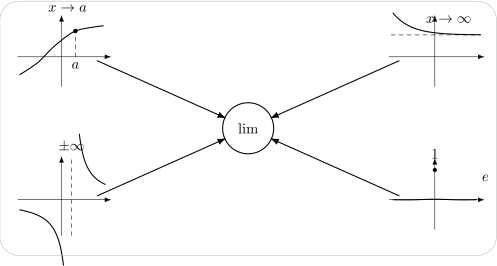
Didactische uitwerking: limiet van een veeltermfunctie, limiet van een rationale functie, limiet van een irrationale functie, limiet van een goniometrische functie; \(x\to a\), \(x\to \pm \infty \); continuïteit; linker- en rechterlimiet; horizontaal en verticaal asymptotisch gedrag; tekenverloop; hoogstegraadsterm; toegevoegde uitdrukking.
Extra uitleg: bijzondere limieten voor \(x\to 0\); \(\lim _{x\to 0}\frac {\sin x}{x}=1\); \(\lim _{x\to 0}\frac {x}{\sin x}=1\); \(\lim _{x\to 0}\frac {\tan x}{x}=1\); \(\lim _{x\to 0}\frac {x}{\tan x}=1\); limiet die het getal van Euler definieert; gelijkwaardige vormen van de Eulerlimiet; onbepaalde vormen.
I Limiet van een veeltermfunctie
1 \(x \to a\)
Regel
\[ \lim _{x \to a} f(x) = f(a) \qquad \text {(veeltermfunctie is cont. in } \R \text {)} \]
Voorbeeld
\(\seteqnumber{0}{}{0}\)\begin{align*} \lim _{x \to 3} (2x^3 + 5x - 7) &= 2 \cdot 3^3 + 5 \cdot 3 - 7 \\ &= 62. \end{align*}
2 \(x \to \pm \infty \)
Voorbeeld 1
\(\seteqnumber{0}{}{0}\)\begin{align*} \lim _{x \to +\infty } (5x^3 + 3x^2 + 2x + 8) &= +\infty + \infty + \infty + 8 \\ &= +\infty \\ &= \lim _{x \to +\infty } 5x^3 \end{align*}
Voorbeeld 2
\(\seteqnumber{0}{}{0}\)\begin{align*} \lim _{x \to +\infty } (5x^3 - 3x^2 + 2x + 8) &= \vov {+\infty - \infty } \qquad \text {VOV!} \\ &= \lim _{x \to +\infty } 5x^3\left (1 - \frac {3}{5x} + \frac {2}{5x^2} + \frac {8}{5x^3}\right ) \\ &= \lim _{x \to +\infty } (5x^3) \cdot \lim _{x \to +\infty } \left (1 - \frac {3}{5x} + \frac {2}{5x^2} + \frac {8}{5x^3}\right ) \qquad \text {lim. v. prod.} \\ &= +\infty \cdot (1 - 0 + 0 + 0) \\ &= +\infty \\ &= \lim _{x \to +\infty } 5x^3 \end{align*}
Regel
\[ \boxed { \text {Als } p(x)=a_nx^n+a_{n-1}x^{n-1}+\cdots +a_1x+a_0 \text { met } a_n \neq 0, \text { dan } \lim _{x \to \pm \infty } p(x) = \lim _{x \to \pm \infty } a_nx^n. } \]
limiet v/e veeltermfunctie voor \(x \to \pm \infty =\) limiet v/d hoogstegraadsterm.
3 Oefeningen
VBTL - Analyse 2 p86, nr1
II Limiet van rationale functie
1 \(x \to a\)
Voorbeeld 1
\[ \lim _{x \to 2} \frac {x^2 - 1}{x + 3} = \frac {3}{5} \qquad \text {merk op: } x = 2 \in \dom f \]
Voorbeeld 2
\(\seteqnumber{0}{}{0}\)\begin{align*} \lim _{\substack {x \to 3 \\ < \\ >}} \frac {x + 1}{x^2 - 9} &= \frac {4}{0} \\ &= \substack {- \\ +}\infty \end{align*}
\[ \begin {array}{c|ccccccc} x & & -3 & & -1 & & 3 & \\ \hline T=x+1 & - & - & - & 0 & + & + & + \\ N=x^2-9 & + & 0 & - & - & - & 0 & + \\ \hline f(x) & - & | & + & 0 & - & | & + \end {array} \]
Merk op: \(a = 3 \notin \dom f\), nulw \(N\), \(\cancel {\text {nulw } T}\). Dus \(\boxed {x = 3 \text { is VA!}}\)
Voorbeeld 3
\(\seteqnumber{0}{}{0}\)\begin{align*} \lim _{x \to 1} \frac {x^2 - 1}{x - 1} &= \vov {\frac {0}{0}} && \text {VOV!} \\ &= \lim _{x \to 1} \frac {(x - 1)(x + 1)}{x - 1} \\ &= \lim _{x \to 1} \frac {\cancel {(x - 1)}(x + 1)}{\cancel {x - 1}} \\ &= \lim _{x \to 1} (x + 1) \\ &= 2. \end{align*}
Merk op: \(a = 1 \notin \dom f\), nulw \(N\), nulw \(T\).
Als \(x=1\) zowel nulw \(T\) als nulw \(N\) is, kunnen we in \(T\) en \(N\) factor \((x-1)\) voorop zetten.
Regel
Voor de rationale functie \(f = \dfrac {T(x)}{N(x)}\) geldt:
\[ \begin {array}{ll} a \in \dom f & \displaystyle \lim _{x \to a} f(x) = f(a) \\[2ex] \text {nulw } N,\ \cancel {\text {nulw } T} & \displaystyle \lim _{x \to a} f(x) = \pm \infty , \quad \text {t.v. voor } +\infty \text { of } -\infty \\[2ex] \text {nulw } N,\ \text {nulw } T & \text {zet in } T \text { en } N \text { factor } (x-a) \text { voorop en schrap deze.} \end {array} \]
\[ \boxed { \lim _{x \to a} \frac {T(x)}{N(x)} = \begin {cases} \dfrac {T(a)}{N(a)} & \text {als } N(a) \neq 0, \\[2ex] \pm \infty & \text {als } N(a)=0 \text { en } T(a)\neq 0, \\[2ex] \displaystyle \lim _{x \to a} \frac {T_1(x)}{N_1(x)} & \text {als } T(a)=N(a)=0, \end {cases} } \]
met \(T(x)=(x-a)T_1(x)\) en \(N(x)=(x-a)N_1(x)\).
2 \(x \to \pm \infty \)
Voorbeeld
\(\seteqnumber{0}{}{0}\)\begin{align*} \lim _{x \to -\infty } \frac {2x^3 + x^2 - 5x + 7}{3x^2 + 8x - 1} & = \vov {\frac {\infty }{\infty }} && \text {VOV!} \\ & = \lim _{x \to -\infty } \frac {x^3\left (2 + \frac {1}{x} - \frac {5}{x^2} + \frac {7}{x^3}\right )} {x^2\left (3 + \frac {8}{x} - \frac {1}{x^2}\right )} && \text {hoogstegraadsterm voorop} \\ & = \lim _{x \to -\infty } \frac {2x^3}{3x^2} && \text {overige factoren} \to \tfrac {2}{3} \\ & = \lim _{x \to -\infty } \frac {2x}{3} && \text {vereenvoudigen} \\ & = \frac {2}{3}(-\infty ) \\ & = -\infty . \end{align*}
Regel
Als \(T(x)=a_nx^n+\cdots +a_1x+a_0\) en \(N(x)=b_mx^m+\cdots +b_1x+b_0\), dan:
\(\seteqnumber{0}{}{0}\)\begin{align*} \lim _{x \to \pm \infty } \frac {T(x)}{N(x)} &= \lim _{x \to \pm \infty } \frac {a_nx^n}{b_mx^m} \\ &= \lim _{x \to \pm \infty } \frac {a_n}{b_m}x^{\,n-m} \qquad \text {na vereenvoudiging!} \end{align*}
limiet v/e rat. \(f\) voor \(x \to \pm \infty \) = limiet v/h quotiënt v/d hoogstegraadstermen
Voorbeelden
\(\seteqnumber{0}{}{0}\)\begin{align*} \lim _{x \to +\infty } \frac {7x^4 + 8x}{3x^3} &= \lim _{x \to +\infty } \frac {7x^4}{3x^3} = \lim _{x \to +\infty } \frac {7x}{3} = +\infty . \\[1ex] \lim _{x \to -\infty } \frac {5x^2 + 7}{2x^2 - 8} &= \lim _{x \to -\infty } \frac {5x^2}{2x^2} = \frac {5}{2}. \\[1ex] \lim _{x \to -\infty } \frac {4x + 4}{7x^4 + 5x^2} &= \lim _{x \to -\infty } \frac {4x}{7x^4} = \lim _{x \to -\infty } \frac {4}{7x^3} = 0. \end{align*}
3 Oefeningen
VBTL – Analyse 2: p 86, nr 2
III Limiet van een irrationale functie
1 \(x \to a\)
Voorbeeld 1
\[ \lim _{x \to 1}(\sqrt {x+3}-2)=0 \qquad \text {merk op: } a=1 \in \dom f \]
\[ \lim _{x \to 6}(\sqrt {x+3}-2)=1 \qquad \text {merk op: } a=6 \in \dom f \]
Voorbeeld 2
\begin{align*} \lim _{x \to 2} \frac {3x+5}{\sqrt {x-2}} &= \frac {11}{0} \\ &= +\infty . \end{align*}
\[ \begin {array}{c|ccccc} x & & -\frac 53 & & 2 & \\ \hline T & - & 0 & + & + & + \\ N & / & / & / & 0 & + \\ f & / & / & / & / & + \end {array} \]
Merk op: \(a=2 \notin \dom f\), \(a=\text {nulw } N\), \(\cancel {\text {nulw } T}\).
Voorbeeld 3
\(\seteqnumber{0}{}{0}\)\begin{align*} \lim _{x \to 1} \frac {\sqrt {x+3}-2}{x-1} &= \vov {\frac 00} && \text {VOV!} \\ &= \lim _{x \to 1} \frac {\sqrt {x+3}-2}{x-1} \cdot \frac {\sqrt {x+3}+2}{\sqrt {x+3}+2} \\ &= \lim _{x \to 1} \frac {x+3-4}{(x-1)(\sqrt {x+3}+2)} \\ &= \lim _{x \to 1} \frac {\cancel {x-1}}{\cancel {x-1}(\sqrt {x+3}+2)} \\ &= \frac {1}{4}. \end{align*}
Vermenigvuldig \(T\) en \(N\) met de toegevoegde uitdrukking van de wortelvorm. Schrap daarna factor \((x-a)\) in \(T\) en \(N\).
Regel
Voor de limiet van een irrationale functie \(f\) voor \(x \to a\) geldt:
\[ \begin {array}{ll} a \in \dom f & \displaystyle \lim _{x \to a} f(x)=f(a) \\[2ex] a \notin \dom f \text { en } a=\text {nulw } N,\ \cancel {\text {nulw } T} & \displaystyle \lim _{x \to a} f(x)=\pm \infty , \quad \text {t.v.} \\[2ex] a \notin \dom f \text { en } a=\text {nulw } N,\ \text {nulw } T & \begin {array}{l} \text {T en N vermenigvuldigen met de toegevoegde} \\ \text {uitdrukking van de wortelvorm;} \\ \text {factor } (x-a) \text { schrappen.} \end {array} \end {array} \]
\[ \boxed { \lim _{x \to a} f(x) = \begin {cases} f(a) & \text {als } a \in \dom f, \\[1ex] \pm \infty & \text {als } a \notin \dom f,\ a=\text {nulw } N,\ \cancel {\text {nulw } T} \quad (\text {t.v.}), \\[1ex] \displaystyle \lim _{x \to a} f_1(x) & \text {als } a \notin \dom f,\ a=\text {nulw } N,\ \text {nulw } T. \end {cases} } \]
Bij \(\vov {\frac 00}\): vermenigvuldig met de toegevoegde uitdrukking en schrap \((x-a)\).
2 \(x \to \pm \infty \)
Geval 1: \(f(x)=\) breuk
Vorm \(\vov {\frac {\infty }{\infty }}\).
Voorbeeld 1
\(\seteqnumber{0}{}{0}\)\begin{align*} & & \lim _{x \to +\infty } \frac {\sqrt {x^2+5}+2x}{3x+1} & = \vov {\frac {\infty }{\infty }} && \text {VOV!} \\ & = & \lim _{x \to +\infty } \frac {\sqrt {x^2\left (1+\frac {5}{x^2}\right )}+2x}{3x+1} & \\ & = & \lim _{x \to +\infty } \frac {x\sqrt {1+\frac {5}{x^2}}+2x}{x\left (3+\frac 1x\right )} & \\ & = & \lim _{x \to +\infty } \frac {\cancel {x}\left (\sqrt {1+\frac {5}{x^2}}+2\right )} {\cancel {x}\left (3+\frac 1x\right )} & \\ & = & \frac {\sqrt {1+0}+2}{3+0} & = 1. \end{align*}
We proberen de hoogstegraadsterm voorop te plaatsen. Let op: \(\sqrt {x^2}=|x|\).
\[ \sqrt {x^2} = \begin {cases} +x & \text {als } x \in \R ^+ \quad (x \to +\infty ),\\ -x & \text {als } x \in \R ^- \quad (x \to -\infty ). \end {cases} \]
Voorbeeld 2
\(\seteqnumber{0}{}{0}\)\begin{align*} & & \lim _{x \to -\infty } \frac {\sqrt {x^2+5x}+2x}{3x-1} & = \vov {\frac {\infty -\infty }{\infty }} && \text {VOV!} \\ & = & \lim _{x \to -\infty } \frac {-x\sqrt {1+\frac 5x}+2x}{x\left (3-\frac 1x\right )} & \\ & = & \lim _{x \to -\infty } \frac {\cancel {x}\left (-\sqrt {1+\frac 5x}+2\right )} {\cancel {x}\left (3-\frac 1x\right )} & \\ & = & \frac {-1+2}{3} & = \frac 13. \end{align*}
Regel
Limiet voor \(x \to \pm \infty \) van een irrationale breuk:
Zet in \(T\) en \(N\) de hoogstegraadsterm voorop en vereenvoudig.
Let op:
\[ \begin {array}{ll} x \to +\infty : & \sqrt {x^2}=+x,\\[0.5ex] x \to -\infty : & \sqrt {x^2}=-x. \end {array} \]
Geval 2: \(f(x)\) is geen breuk
Vorm \(\vov {+\infty -\infty }\).
Voorbeeld 1
\[ \lim _{x \to +\infty } \left (\sqrt {4x^2+3x}+2x\right ) = +\infty \quad \Rightarrow \quad \text {geen VOV} \Rightarrow \text {geen probleem} \]
Voorbeeld 2
\(\seteqnumber{0}{}{0}\)\begin{align*} \lim _{x \to -\infty } \left (\sqrt {4x^2+3x}+2x\right ) & = \vov {+\infty -\infty } && \text {VOV} \\ & = \lim _{x \to -\infty } \frac {\left (\sqrt {4x^2+3x}+2x\right ) \left (\sqrt {4x^2+3x}-2x\right )} {\sqrt {4x^2+3x}-2x} & \\ & = \lim _{x \to -\infty } \frac {4x^2+3x-4x^2} {\sqrt {4x^2+3x}-2x} & \\ & = \lim _{x \to -\infty } \frac {3x} {\sqrt {4x^2+3x}-2x} = \vov {\frac {-\infty }{+\infty }} \\ & = \lim _{x \to -\infty } \frac {3x} {-x\sqrt {4+\frac 3x}-2x} & \\ & = \lim _{x \to -\infty } \frac {\cancel {x} \cdot 3} {\cancel {x}\left (-\sqrt {4+\frac 3x}-2\right )} & \\ & = \frac {3}{-2-2} = -\frac 34. \end{align*}
Regel
Als bij de limiet voor \(x \to \pm \infty \) van een irrationale functie die geen breuk is de uitkomst \(\vov {+\infty -\infty }\) is, dan:
-
• vermenigvuldigen we \(T\) en \(N\) met de toegevoegde uitdrukking van \(T\);
-
• zetten we vervolgens de hoogstegraadsterm in \(T\) en \(N\) voorop.
Opmerking
Vergeet niet vooraf de onbepaaldheid te controleren!!
3 Oefeningen
VBTL – Analyse 2: p 87 nr 4, 5, 6
IV Limiet van een goniometrische functie
1 \(x \to a\)
Regel
\[ \begin {array}{ll} \sin x,\ \cos x & \text {continu in } \R , \\[1ex] \tan x & \text {continu in } \dom (\tan ) = \R \setminus \left \{\frac {\pi }{2}+k\pi \mid k \in \Z \right \}, \\[1ex] \cot x & \text {continu in } \dom (\cot ) = \R \setminus \{k\pi \mid k \in \Z \}. \end {array} \]
\[ a \in \dom f \quad \Rightarrow \quad \lim _{x \to a} f(x)=f(a) \]
Voorbeeld 1
\(\seteqnumber{0}{}{0}\)\begin{align*} \lim _{x \to \frac {\pi }{6}} \left (2\sin x+\cos 2x\right ) &= 2\sin \frac {\pi }{6}+\cos \frac {\pi }{3} \\ &= 2\cdot \frac 12+\frac 12 \\ &= \frac 32. \end{align*}
Voorbeeld 2
\(\seteqnumber{0}{}{0}\)\begin{align*} \lim _{\substack {x \to \frac {\pi }{2} \\ < \\ >}} \tan x &= \frac {\sin \frac {\pi }{2}}{\cos \frac {\pi }{2}} \\ &= \frac {1}{0} \\ &= \substack {+ \\ -}\infty \end{align*}
\[ \begin {array}{c|ccc} x & & \frac {\pi }{2} & \\ \hline \sin x & + & 1 & + \\ \cos x & + & 0 & - \\ \hline \tan x & + & | & - \end {array} \]
Merk op: \(a=\frac {\pi }{2} \notin \dom (\tan )\). Dus \(\boxed {x=\frac {\pi }{2} \text { is VA!}}\)
2 Bijzondere limieten voor \(x \to 0\)
Opstellen formule
Alle hoeken in radialen!
\[ \begin {array}{c|ccccc} x & 1 & 0.1 & 0.01 & 0.001 & 0.0001 \\ \hline \dfrac {\sin x}{x} & 0.841471 & 0.998334 & 0.999983 & 1.000000 & 1.000000 \end {array} \]
Uit de tabel blijkt dat \(\dfrac {\sin x}{x}\) naar \(1\) nadert als \(x\) dichter bij \(0\) komt.
Regel
\[ \boxed { \lim _{x \to 0}\frac {\sin x}{x}=1 } \]
Bewijs: Is mogelijk m.b.v. l’Hospital, zie later.
Afgeleide formule 1
\[ \boxed { \lim _{x \to 0}\frac {x}{\sin x}=1 } \]
Bewijs:
\(\seteqnumber{0}{}{0}\)\begin{align*} \lim _{x \to 0}\frac {x}{\sin x} &= \lim _{x \to 0}\frac {1}{\frac {\sin x}{x}} \\ &= \frac {1}{1} \\ &= 1. \end{align*}
Afgeleide formule 2
\[ \boxed { \lim _{x \to 0}\frac {\tan x}{x}=1 } \]
Bewijs:
\(\seteqnumber{0}{}{0}\)\begin{align*} \lim _{x \to 0}\frac {\tan x}{x} &= \lim _{x \to 0}\frac {\sin x}{x\cos x} \\ &= \lim _{x \to 0} \left (\frac {\sin x}{x}\cdot \frac {1}{\cos x}\right ) \\ &= 1 \cdot \frac {1}{1} \\ &= 1. \end{align*}
Afgeleide formule 3
\[ \boxed { \lim _{x \to 0}\frac {x}{\tan x}=1 } \]
Bewijs:
\(\seteqnumber{0}{}{0}\)\begin{align*} \lim _{x \to 0}\frac {x}{\tan x} &= \lim _{x \to 0}\frac {1}{\frac {\tan x}{x}} \\ &= \frac {1}{1} \\ &= 1. \end{align*}
Voorbeeld 1
\(\seteqnumber{0}{}{0}\)\begin{align*} \lim _{x \to 0}\frac {\sin 5x}{2x} &= \lim _{x \to 0}\left (\frac {\sin 5x}{5x}\cdot \frac 52\right ) \\ &= 1\cdot \frac 52 \\ &= \frac 52. \end{align*}
Voorbeeld 2
\(\seteqnumber{0}{}{0}\)\begin{align*} \lim _{x \to 0}\frac {1-\cos x}{x^2} &= \vov {\dfrac 00} && \text {VOV!} \\ &= \lim _{x \to 0}\frac {1-\cos x}{x^2} \cdot \frac {1+\cos x}{1+\cos x} \\ &= \lim _{x \to 0}\frac {1-\cos ^2 x}{x^2(1+\cos x)} \\ &= \lim _{x \to 0}\frac {\sin ^2 x}{x^2(1+\cos x)} \\ &= \lim _{x \to 0}\left (\frac {\sin x}{x}\right )^2 \cdot \frac {1}{1+\cos x} \\ &= 1^2 \cdot \frac {1}{1+1} \\ &= \frac 12. \end{align*}
Bij \(\vov {\frac 00}\): probeer \(\dfrac {\sin u}{u}\) te bekomen of gebruik de toegevoegde uitdrukking.
3 \(x \to \pm \infty \)
Regel
\[ \lim _{x \to \pm \infty }\sin x \quad \text {en} \quad \lim _{x \to \pm \infty }\cos x \quad \text {bestaan niet.} \]
\[ -1 \leq \sin x \leq 1, \qquad -1 \leq \cos x \leq 1. \]
\[ \begin {array}{c} h(x) \text { begrensd en } \lim \limits _{x \to \pm \infty } g(x)=0 \\[1ex] \Downarrow \\[1ex] \lim \limits _{x \to \pm \infty } h(x)\,g(x)=0 \end {array} \]
Voorbeeld 1
\(\seteqnumber{0}{}{0}\)\begin{align*} \lim _{x \to \pm \infty }\frac {\sin x}{x} &= \lim _{x \to \pm \infty }\left (\sin x \cdot \frac 1x\right ) \\ &= \text {begrensd} \cdot 0 \\ &= 0. \end{align*}
\[ \boxed { \lim _{x \to \pm \infty }\frac {\sin x}{x}=0 } \]
Voorbeeld 2
\(\seteqnumber{0}{}{0}\)\begin{align*} \lim _{x \to +\infty }\sin \frac 1x &= \sin \left (\lim _{x \to +\infty }\frac 1x\right ) \\ &= \sin 0 \\ &= 0. \end{align*}
4 Oefeningen
VBTL – Analyse 2: p 87 nr 7, 8
V Limiet die het getal van Euler definieert
1 Definitie
Motivatie
\[ \begin {array}{c|cccccc} n & 1 & 2 & 5 & 10 & 100 & 1000 \\ \hline \left (1+\frac 1n\right )^n & 2 & 2.25 & 2.48832 & 2.59374 & 2.70481 & 2.71692 \end {array} \]
Voor steeds grotere waarden van \(n\) komen de getallen dichter bij \(e \approx 2.71828\).
Definitie van \(e\)
\[ e := \lim _{n \to +\infty }\left (1+\frac 1n\right )^n \]
\[ e \approx 2.71828 \]
Dit is geen rekenregel, maar de definitie van het getal van Euler. We spreken af dat de limiet \(\displaystyle \lim _{n \to +\infty }\left (1+\frac 1n\right )^n\) gelijk is aan het getal \(e\).
Opmerking
De limiet heeft de onbepaalde vorm \(\vov {1^\infty }\): de basis \(\displaystyle 1+\frac 1n\) nadert naar \(1\), terwijl de exponent \(n\) naar \(+\infty \) gaat.
2 Gelijkwaardige vorm 1
\[ \boxed { \lim _{x \to +\infty }\left (1+\frac 1x\right )^x = e } \]
Bewijs: Dit is dezelfde limiet als in de definitie, maar met een reële veranderlijke \(x\) in plaats van een natuurlijke veranderlijke \(n\).
3 Gelijkwaardige vorm 2
\[ \boxed { \lim _{x \to -\infty }\left (1+\frac 1x\right )^x = e } \]
Bewijs: Stel \(t=-x\). Dan \(t \to +\infty \) en
\(\seteqnumber{0}{}{0}\)\begin{align*} \lim _{x \to -\infty }\left (1+\frac 1x\right )^x &= \lim _{t \to +\infty }\left (1-\frac 1t\right )^{-t} \\ &= \lim _{t \to +\infty }\left (\frac {t}{t-1}\right )^t \\ &= \lim _{t \to +\infty }\left (1+\frac 1{t-1}\right )^t \\ &= \lim _{t \to +\infty } \underbrace { \left (1+\frac 1{t-1}\right )^{t-1} }_{\to e} \underbrace { \left (1+\frac 1{t-1}\right ) }_{\to 1} \\ &= e. \end{align*}
4 Gelijkwaardige vorm 3
\[ \boxed { \lim _{x \to 0}(1+x)^{\frac 1x} = e } \]
Bewijs: Stel \(t=\dfrac 1x\). Dan \(x \to 0 \Leftrightarrow t \to \pm \infty \) en
\(\seteqnumber{0}{}{0}\)\begin{align*} \lim _{x \to 0}(1+x)^{\frac 1x} &= \lim _{t \to \pm \infty }\left (1+\frac 1t\right )^t \\ &= e. \end{align*}
5 Voorbeelden
Voorbeeld 1
\(\seteqnumber{0}{}{0}\)\begin{align*} \lim _{x \to +\infty }\left (1+\frac {3}{x}\right )^x &= \vov {1^{+\infty }} && \text {VOV!} \\ &= \lim _{x \to +\infty } \left (1+\frac {1}{\frac {x}{3}}\right )^x \\ &= \lim _{x \to +\infty } \left (1+\frac {1}{\frac {x}{3}}\right )^{3\cdot \frac {x}{3}} \\ &\overset {t=\frac {x}{3}}{=} \lim _{t \to +\infty } \left (1+\frac {1}{t}\right )^{3t} \\ &= \lim _{t \to +\infty } \left [ \left (1+\frac {1}{t}\right )^t \right ]^3 \\ &= \boxed {e^3.} \end{align*}
Voorbeeld 2
\(\seteqnumber{0}{}{0}\)\begin{align*} \lim _{x \to 0}(1+5x)^{\frac {2}{x}} &= \vov {1^\infty } && \text {VOV!} \\ &= \lim _{x \to 0}(1+5x)^{\frac {10}{5x}} \\ &\overset {t=5x}{=} \lim _{t \to 0}(1+t)^{\frac {10}{t}} \\ &= \lim _{t \to 0} \left [ (1+t)^{\frac {1}{t}} \right ]^{10} \\ &= \left [ \lim _{t \to 0} (1+t)^{\frac {1}{t}} \right ]^{10} \\ &= \boxed {e^{10}.} \end{align*}
Voorbeeld 3
\(\seteqnumber{0}{}{0}\)\begin{align*} \lim _{x \to +\infty } \left (\frac {x+4}{x}\right )^{2x-1} &= \lim _{x \to +\infty } \left (1+\frac 4x\right )^{2x-1} && \text {vorm } \vov {1^\infty } \\ &= \lim _{x \to +\infty } \left (1+\frac {1}{\frac {x}{4}}\right )^{2x-1} \\ &= \lim _{x \to +\infty } \left (1+\frac {1}{\frac {x}{4}}\right )^{8\cdot \frac {x}{4}-1} \\ &\overset {t=\frac {x}{4}}{=} \lim _{t \to +\infty } \left (1+\frac 1t\right )^{8t-1} \\ &= \lim _{t \to +\infty } \left [ \left (1+\frac 1t\right )^t \right ]^8 \left (1+\frac 1t\right )^{-1} \\ &= \left [ \lim _{t \to +\infty } \left (1+\frac 1t\right )^t \right ]^8 \cdot \lim _{t \to +\infty } \left (1+\frac 1t\right )^{-1} \\ &= e^8 \cdot 1 \\ &= \boxed {e^8.} \end{align*}
6 Oefeningen
VBTL – Analyse 2: p 89 nr 15