\(\newcommand{\footnotename}{footnote}\)
\(\def \LWRfootnote {1}\)
\(\newcommand {\footnote }[2][\LWRfootnote ]{{}^{\mathrm {#1}}}\)
\(\newcommand {\footnotemark }[1][\LWRfootnote ]{{}^{\mathrm {#1}}}\)
\(\let \LWRorighspace \hspace \)
\(\renewcommand {\hspace }{\ifstar \LWRorighspace \LWRorighspace }\)
\(\newcommand {\TextOrMath }[2]{#2}\)
\(\newcommand {\mathnormal }[1]{{#1}}\)
\(\newcommand \ensuremath [1]{#1}\)
\(\newcommand {\LWRframebox }[2][]{\fbox {#2}} \newcommand {\framebox }[1][]{\LWRframebox } \)
\(\newcommand {\setlength }[2]{}\)
\(\newcommand {\addtolength }[2]{}\)
\(\newcommand {\setcounter }[2]{}\)
\(\newcommand {\addtocounter }[2]{}\)
\(\newcommand {\arabic }[1]{}\)
\(\newcommand {\number }[1]{}\)
\(\newcommand {\noalign }[1]{\text {#1}\notag \\}\)
\(\newcommand {\cline }[1]{}\)
\(\newcommand {\directlua }[1]{\text {(directlua)}}\)
\(\newcommand {\luatexdirectlua }[1]{\text {(directlua)}}\)
\(\newcommand {\protect }{}\)
\(\def \LWRabsorbnumber #1 {}\)
\(\def \LWRabsorbquotenumber "#1 {}\)
\(\newcommand {\LWRabsorboption }[1][]{}\)
\(\newcommand {\LWRabsorbtwooptions }[1][]{\LWRabsorboption }\)
\(\def \mathchar {\ifnextchar "\LWRabsorbquotenumber \LWRabsorbnumber }\)
\(\def \mathcode #1={\mathchar }\)
\(\let \delcode \mathcode \)
\(\let \delimiter \mathchar \)
\(\def \oe {\unicode {x0153}}\)
\(\def \OE {\unicode {x0152}}\)
\(\def \ae {\unicode {x00E6}}\)
\(\def \AE {\unicode {x00C6}}\)
\(\def \aa {\unicode {x00E5}}\)
\(\def \AA {\unicode {x00C5}}\)
\(\def \o {\unicode {x00F8}}\)
\(\def \O {\unicode {x00D8}}\)
\(\def \l {\unicode {x0142}}\)
\(\def \L {\unicode {x0141}}\)
\(\def \ss {\unicode {x00DF}}\)
\(\def \SS {\unicode {x1E9E}}\)
\(\def \dag {\unicode {x2020}}\)
\(\def \ddag {\unicode {x2021}}\)
\(\def \P {\unicode {x00B6}}\)
\(\def \copyright {\unicode {x00A9}}\)
\(\def \pounds {\unicode {x00A3}}\)
\(\let \LWRref \ref \)
\(\renewcommand {\ref }{\ifstar \LWRref \LWRref }\)
\( \newcommand {\multicolumn }[3]{#3}\)
\(\require {textcomp}\)
\(\newcommand {\opl }[2][]{\bbox [whitesmoke, 3px, border: 1px dashed darkseagreen]{\class {opl-math opl-optie-#1}{#2}}}\)
\(\newcommand {\hint }[1]{\class {hint}{#1}}\)
\(\newcommand {\aside }[1]{\class {aside}{#1}}\)
\(\newcommand {\vov }[1]{\aside {{\vphantom {#1}}^{\textstyle \lower {0.7ex}{\text {`}}}\mkern -1mu\mathopen {}#1\mathclose {}\mkern -1mu{\vphantom {#1}}^{\textstyle \lower {0.7ex}{\text
{'}}}}}\)
\(\newcommand {\truc }[1]{\class {truc}{#1}}\)
\(\newcommand {\N }{\mathbb {N}}\)
\(\newcommand {\Z }{\mathbb {Z}}\)
\(\newcommand {\Q }{\mathbb {Q}}\)
\(\newcommand {\R }{\mathbb {R}}\)
\(\newcommand {\C }{\mathbb {C}}\)
\(\newcommand {\E }{\mathrm {E}}\)
\(\newcommand {\T }{\mathsf {T}}\)
\(\newcommand {\dom }{\mathrm {dom}}\)
\(\newcommand {\ber }{\mathrm {ber}}\)
\(\newcommand {\degree }{^{\circ }}\)
\(\newcommand {\Bgsin }{\operatorname {Bgsin}}\)
\(\newcommand {\Bgcos }{\operatorname {Bgcos}}\)
\(\newcommand {\Bgtan }{\operatorname {Bgtan}}\)
\(\newcommand {\Bgcot }{\operatorname {Bgcot}}\)
\(\newcommand {\bgsin }{\operatorname {bgsin}}\)
\(\newcommand {\bgcos }{\operatorname {bgcos}}\)
\(\newcommand {\bgtan }{\operatorname {bgtan}}\)
\(\newcommand {\bgcot }{\operatorname {bgcot}}\)
\(\newcommand {\qed }{\class {mathesis-qed}{\square }}\)
\(\newcommand {\markeercellen }[4][.35]{}\)
\(\newcommand {\celpijl }[3]{}\)
\(\newcommand {\weq }{\ifnextchar [{\weqmet }{\weqzonder }}\)
\(\def \weqmet [#1]{\ifnextchar [{\weqtwee {#1}}{\weqeen {#1}}}\)
\(\def \weqtwee #1[#2]#3{\mathrel {\overset {#1}{\underset {#2}{#3}}}}\)
\(\def \weqeen #1#2{\mathrel {\overset {#1}{#2}}}\)
\(\def \weqzonder #1{\mathrel {#1}}\)
\(\newcommand {\shortstack }[2][]{\substack {#2}}\)
\(\newcommand {\scriptsize }{}\)
\(\newcommand {\tiny }{}\)
\(\newcommand {\tvmax }[1]{\begin {array}{c} \scriptstyle \text {max} \\[-0.8ex] \scriptstyle =#1 \end {array}}\)
\(\newcommand {\tvmin }[1]{\begin {array}{c} \scriptstyle \text {min} \\[-0.8ex] \scriptstyle =#1 \end {array}}\)
\(\newcommand {\markeerterm }[2]{#2}\)
\(\newcommand {\lightning }{\unicode {x21AF}}\)
\(\newcommand {\arceervak }{\enclose {updiagonalstrike}{\phantom {\rule {0em}{1.2ex}}}\kern -0.33em}\)
\(\newcommand {\undefsign }{\class {undefsign}{\arceervak \arceervak \arceervak \arceervak \arceervak \arceervak \arceervak \arceervak \arceervak \arceervak \arceervak \arceervak \arceervak
\arceervak \arceervak \arceervak }}\)
\(\newcommand {\intertext }[1]{\text {#1}\notag \\}\)
\(\let \Hat \hat \)
\(\let \Check \check \)
\(\let \Tilde \tilde \)
\(\let \Acute \acute \)
\(\let \Grave \grave \)
\(\let \Dot \dot \)
\(\let \Ddot \ddot \)
\(\let \Breve \breve \)
\(\let \Bar \bar \)
\(\let \Vec \vec \)
\(\require {mathtools}\)
\(\newcommand {\vcentcolon }{\mathrel {\unicode {x2236}}}\)
\(\newcommand {\approxcolon }{\approx \vcentcolon }\)
\(\newcommand {\Approxcolon }{\approx \dblcolon }\)
\(\newcommand {\simcolon }{\sim \vcentcolon }\)
\(\newcommand {\Simcolon }{\sim \dblcolon }\)
\(\newcommand {\dashcolon }{\mathrel {-}\vcentcolon }\)
\(\newcommand {\Dashcolon }{\mathrel {-}\dblcolon }\)
\(\newcommand {\colondash }{\vcentcolon \mathrel {-}}\)
\(\newcommand {\Colondash }{\dblcolon \mathrel {-}}\)
\(\newenvironment {crampedsubarray}[1]{}{}\)
\(\newcommand {\smashoperator }[2][]{#2\limits }\)
\(\newcommand {\SwapAboveDisplaySkip }{}\)
\(\newcommand {\LaTeXunderbrace }[1]{\underbrace {#1}}\)
\(\newcommand {\LaTeXoverbrace }[1]{\overbrace {#1}}\)
\(\Newextarrow \xLongleftarrow {10,10}{0x21D0}\)
\(\Newextarrow \xLongrightarrow {10,10}{0x21D2}\)
\(\let \xlongleftarrow \xleftarrow \)
\(\let \xlongrightarrow \xrightarrow \)
\(\newcommand {\LWRmultlined }[1][]{\begin {multline*}}\)
\(\newenvironment {multlined}[1][]{\LWRmultlined }{\end {multline*}}\)
\(\let \LWRorigshoveleft \shoveleft \)
\(\renewcommand {\shoveleft }[1][]{\LWRorigshoveleft }\)
\(\let \LWRorigshoveright \shoveright \)
\(\renewcommand {\shoveright }[1][]{\LWRorigshoveright }\)
\(\newcommand {\shortintertext }[1]{\text {#1}\notag \\}\)
\(\newcommand {\bm }[1]{\boldsymbol {#1}}\)
\(\newcommand {\toprule }[1][]{\hline }\)
\(\let \midrule \toprule \)
\(\let \bottomrule \toprule \)
\(\def \LWRbooktabscmidruleparen (#1)#2{}\)
\(\newcommand {\LWRbooktabscmidrulenoparen }[1]{}\)
\(\newcommand {\cmidrule }[1][]{\ifnextchar (\LWRbooktabscmidruleparen \LWRbooktabscmidrulenoparen }\)
\(\newcommand {\morecmidrules }{}\)
\(\newcommand {\specialrule }[3]{\hline }\)
\(\newcommand {\addlinespace }[1][]{}\)
\(\newcommand {\LWRnicearrayarray }[1]{\begin {array}{#1}}\)
\(\def \LWRnicearrayarrayopt #1[#2] {\begin {array}{#1}}\)
\(\newenvironment {NiceArray}[2][]{\ifnextchar [{\LWRnicearrayarrayopt {#2}}{\LWRnicearrayarray {#2}}}{\end {array}}\)
\(\newcommand {\LWRnicearraywithdelimtwo }[2][]{\ifnextchar [{\LWRnicearrayarrayopt {#2}}{\LWRnicearrayarray {#2}}}\)
\(\newenvironment {NiceArrayWithDelims}[2]{\def \LWRnicearrayrightdelim {\right #2}\left #1\LWRnicearraywithdelimtwo }{\end {array}\LWRnicearrayrightdelim }\)
\(\newenvironment {pNiceArray} {\begin {NiceArrayWithDelims}{(}{)}} {\end {NiceArrayWithDelims}} \)
\(\newenvironment {bNiceArray} {\begin {NiceArrayWithDelims}{[}{]}} {\end {NiceArrayWithDelims}} \)
\(\newenvironment {BNiceArray} {\begin {NiceArrayWithDelims}{\{}{\}}} {\end {NiceArrayWithDelims}} \)
\(\newenvironment {vNiceArray} {\begin {NiceArrayWithDelims}{\vert }{\vert }} {\end {NiceArrayWithDelims}} \)
\(\newenvironment {VNiceArray} {\begin {NiceArrayWithDelims}{\Vert }{\Vert }} {\end {NiceArrayWithDelims}} \)
\(\newenvironment {NiceMatrix}[1][]{\begin {matrix}}{\end {matrix}}\)
\(\newenvironment {pNiceMatrix}[1][]{\begin {pmatrix}}{\end {pmatrix}}\)
\(\newenvironment {bNiceMatrix}[1][]{\begin {bmatrix}}{\end {bmatrix}}\)
\(\newenvironment {BNiceMatrix}[1][]{\begin {Bmatrix}}{\end {Bmatrix}}\)
\(\newenvironment {vNiceMatrix}[1][]{\begin {vmatrix}}{\end {vmatrix}}\)
\(\newenvironment {VNiceMatrix}[1][]{\begin {Vmatrix}}{\end {Vmatrix}}\)
\(\newcommand {\LWRnicematrixBlock }[1]{#1}\)
\(\def \LWRnicematrixBlockopt <#1>#2{#2}\)
\(\newcommand {\Block }[2][]{\ifnextchar <\LWRnicematrixBlockopt \LWRnicematrixBlock }\)
\(\newcommand {\diagbox }[2]{\begin {array}{l}\hfill \quad #2\\\hline #1\quad \hfill \end {array}}\)
\(\let \hdottedline \hdashline \)
\(\newcommand {\Hline }[1][]{\hline }\)
\(\newcommand {\CodeBefore }{}\)
\(\newcommand {\Body }{}\)
\(\newcommand {\CodeAfter }{}\)
\(\newcommand {\line }[3][]{}\)
\(\newcommand {\RowStyle }[2][]{}\)
\(\newcommand {\LWRSubMatrix }[1][]{}\)
\(\newcommand {\SubMatrix }[4]{\LWRSubMatrix }\)
\(\newcommand {\OverBrace }[4][]{}\)
\(\newcommand {\UnderBrace }[4][]{}\)
\(\newcommand {\HBrace }[3][]{}\)
\(\newcommand {\VBrace }[3][]{}\)
\(\newcommand {\ShowCellNames }{}\)
\(\newcommand {\tabularnote }[2][]{}\)
\(\newcommand {\cellcolor }[3][]{}\)
\(\newcommand {\rowcolor }[3][]{}\)
\(\newcommand {\LWRrowcolors }[1][]{}\)
\(\newcommand {\rowcolors }[4][]{\LWRrowcolors }\)
\(\newcommand {\rowlistcolors }[3][]{\LWRrowcolors }\)
\(\newcommand {\columncolor }[3][]{}\)
\(\newcommand {\rectanglecolor }[4][]{}\)
\(\newcommand {\arraycolor }[2][]{}\)
\(\newcommand {\chessboardcolors }[3][]{}\)
\(\newcommand {\ldots }[1][]{\dots }\)
\(\newcommand {\Cdots }[1][]{\cdots }\)
\(\newcommand {\Vdots }[1][]{\vdots }\)
\(\newcommand {\Ddots }[1][]{\ddots }\)
\(\newcommand {\Iddots }[1][]{\mathinner {\unicode {x22F0}}}\)
\(\newcommand {\Hdotsfor }[1]{\ldots }\)
\(\newcommand {\Vdotsfor }[1]{\vdots }\)
\(\newcommand {\AutoNiceMatrix }[2]{\text {(AutoNiceMatrix #1)}}\)
\(\let \pAutoNiceMatrix \AutoNiceMatrix \)
\(\let \bAutoNiceMatrix \AutoNiceMatrix \)
\(\let \BAutoNiceMatrix \AutoNiceMatrix \)
\(\let \vAutoNiceMatrix \AutoNiceMatrix \)
\(\let \VAutoNiceMatrix \AutoNiceMatrix \)
\(\require {cancel}\)
\(\newcommand {\LWRsubmultirow }[2][]{#2}\)
\(\newcommand {\LWRmultirow }[2][]{\LWRsubmultirow }\)
\(\newcommand {\multirow }[2][]{\LWRmultirow }\)
\(\newcommand {\mrowcell }{}\)
\(\newcommand {\mcolrowcell }{}\)
\(\newcommand {\STneed }[1]{}\)
\(\newcommand {\LWRldelimtwo }[1][]{\text {#1}~\LWRbigdelim }\)
\(\newcommand {\LWRldelimone }[2][]{\LWRldelimtwo }\)
\(\def \ldelim #1#2{\def \LWRbigdelim {#1}\LWRldelimone }\)
\(\newcommand {\LWRrdelimtwo }[1][]{\LWRbigdelim ~\text {#1}}\)
\(\newcommand {\LWRrdelimone }[2][]{\LWRrdelimtwo }\)
\(\def \rdelim #1#2{\def \LWRbigdelim {#1}\LWRrdelimone }\)
Hoofdstuk 7
Exponentiële groei
Leerplandoelstellingen (GO! Navigator)
Basisvorming (BV3_06)
-
• BV3_06.05 (MD 06.05) De leerlingen analyseren kenmerken van de functie \(f(x)=a^x\): domein, bereik, stijgen/dalen, toenemende
stijging/afnemende daling, horizontale asymptoot en gedrag op oneindig.
-
• BV3_06.06 (MD 06.06) De leerlingen gebruiken modellen voor exponentiële groei.
-
• BV3_06.07 (MD 06.07) De leerlingen gebruiken transformaties van de vorm \(f(x)+k\) en \(k\cdot f(x)\) om de grafiek van een algemene exponentiële functie
\(f(x)=b\cdot a^x+c\) op te bouwen vanuit de grafiek van \(f(x)=a^x\).
Gevorderde wiskunde (WD3_06.08)
-
• WD3_06.08.18 (MD 06.08.13) De leerlingen lossen eenvoudige veeltermvergelijkingen, rationale
vergelijkingen, irrationale vergelijkingen, exponentiële vergelijkingen, logaritmische vergelijkingen en goniometrische vergelijkingen algebraïsch op.
-
• WD3_06.08.21 (MD 06.08.07) De leerlingen leggen het verband tussen de grafiek en het voorschrift van een functie en haar kenmerken.
-
– afbakening: veeltermfuncties, rationale functies, (elementaire)
irrationale functies, exponentiële functies, logaritmische functies \(f(x)=\log _a(x)\), goniometrische functies \(f(x)=\cos x\) en
\(f(x)=\tan x\), cyclometrische functies, absolute waardenfunctie, meervoudig
functievoorschrift
-
– afbakening: domein, bereik, nulwaarden, tekenverloop, stijgen/dalen/constant, extrema, constante/toenemende/afnemende stijging/daling, symmetrie, periode, amplitude, asymptotisch gedrag, gedrag op oneindig
Didactische uitwerking: lineaire groei, exponentiële groei, procentuele toename, afname, exponentiële functies, functies met voorschrift \(f(x)=b\cdot a^x\), exponentiële vergelijkingen
Extra uitleg: machten met reële exponenten
I Inleiding
Stel dat je twee spaarplannen vergelijkt.
We onderzoeken beide plannen tot aan een belangrijke gebeurtenis, bijvoorbeeld een achttiende verjaardag.
1 Tabel
| . |
|---|
| jaar |
plan A |
plan B |
| 0 |
1000 |
1 |
| 1 |
1100 |
2 |
| 2 |
1200 |
4 |
| 3 |
1300 |
8 |
| 4 |
1400 |
16 |
| 5 |
1500 |
32 |
| 6 |
1600 |
64 |
| 7 |
1700 |
128 |
| 8 |
1800 |
256 |
| 9 |
1900 |
512 |
| 10 |
2000 |
1024 |
| ⋮ |
⋮ |
⋮ |
| 18 |
2800 |
262144 |
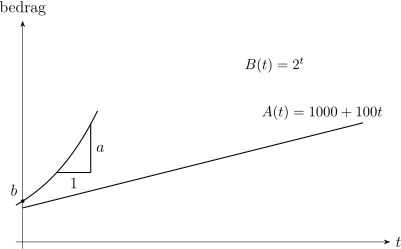
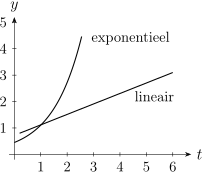
Plan A groeit elke keer met een vast bedrag. Plan B groeit elke keer met een vaste factor.
2 Formules
Voor plan A kunnen we rechtstreeks schrijven:
\[ A(t)=1000+100t. \]
Voor plan B krijgen we:
\[ B(t)=1\cdot 2^t=2^t. \]
3 Grafische voorstelling
II Lineair versus exponentieel
1 Lineaire groei
Definitie
Bij lineaire groei ontstaat de volgende waarde uit de vorige door telkens een vast getal op te tellen, telkens
na gelijke tijdsintervallen.
Grafiek
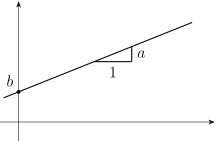
De grafiek van een lineair verband is een rechte.
Functievoorschrift
\[ f(x)=ax+b \]
met:
Opmerking
Als \(x\) een rekenkundige rij vormt, dan vormt \(f(x)\) opnieuw een rekenkundige rij.
2 Exponentiële groei
Definitie
Bij exponentiële groei ontstaat de volgende waarde uit de vorige door telkens met een \(\underbrace
{\text {vast getal}}_{\text {groeifactor}}\) te vermenigvuldigen.
Grafiek
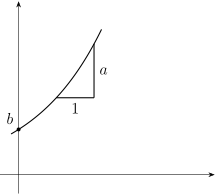
De grafiek van een exponentieel verband is een kromme.
Functievoorschrift
\[ f(x)=b\cdot a^x \]
met:
-
• \(b\) de beginwaarde,
-
• \(a\) de groeifactor.
Opmerking
Als \(x\) een rekenkundige rij vormt, dan vormt \(f(x)\) een meetkundige rij.
Vergelijk:
\[ 3,6,9,12,\dots \qquad \text {en}\qquad 2,4,8,16,\dots \]
De eerste rij is rekenkundig, want we tellen telkens \(3\) op. De tweede rij is meetkundig, want we vermenigvuldigen telkens met
\(2\).
Oefening
p85 nr2 (Met GRM)
III Procentuele toe- en afname
1 Procentuele toename
Voorbeeld
Een kapitaal van €2500 wordt belegd aan \(5\%\) interest per jaar.
Dus jaarlijkse intrest: \(5\%\)
Dus jaarlijkse toename: \(100\% + 5\% = 105\%\)
Dus groeifactor is:
\[ 1+\frac {5}{100}=1.05 \]
Dus na \(t\) jaar is het kapitaal:
\[ K(t)=2500\cdot 1.05^t. \]
Definitie
Als een grootheid met \(p\%\) toeneemt per tijdseenheid, dan wordt ze telkens vermenigvuldigd met de factor
\[ \underbrace {1+\frac {\overbrace {p}^{\text {\textbf {groepercentage}}}}{100}}_{\text {\textbf {groeifactor}}} \]
Een procentuele toename betekent dus geen vaste som, maar een vaste vermenigvuldigingsfactor.
Als de beginwaarde gelijk is aan \(N_0\), dan is de formule voor exponentiële groei:
\[ N_t=N_0 \cdot \left (1+\frac {p}{100}\right )^t. \]
2 Afname
Een afname van \(p\%\) betekent dat we vermenigvuldigen met
\[ 1-\frac {p}{100}. \]
De groeifactor is dus:
\[ a=1-\frac {p}{100}. \]
Graf Zeppelin
Een luchtschip bevat aanvankelijk \(105000\,\text {m}^3\) helium. Om de \(10\) dagen blijft nog de helft over.
Dan geldt:
\[ V(t)=105000\cdot 0.5^t, \]
waarbij \(t\) uitgedrukt wordt in tientallen dagen.
Wat is de procentuele afname per dag?
\(\seteqnumber{0}{}{0}\)
\begin{align*}
0.5^{t/10} &= \bigl ((0.5)^{1/10}\bigr )^t\\ &= \sqrt [10]{0.5}^t \\ &\approx 0.933^t \\ \Rightarrow \qquad p\% &\approx 0.067\%
\end{align*}
Daarmee krijgen we:
\[ V(t)=105000\cdot 0.933^t, \]
waarbij \(t\) nu het aantal dagen voorstelt.
3 Oefeningen
p85 nr 4, 12, 13, 14, 15 (met GRM)
IV Machten met reële exponenten
Bij exponentiële functies \(a^x\): \(x\) vaak reëel!
Gebruik GRM.
Dit steunt op de uitbreiding van het begrip macht: eerst naar gehele exponenten, daarna naar rationale exponenten en uiteindelijk
naar reële exponenten.
V Exponentiële functies
1 Definitie
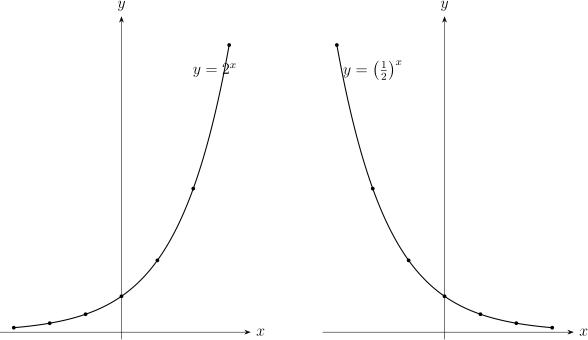
Voor elk grondtal \(a\in \R _0^+\setminus \{1\}\) definiëren we de exponentiële functie met
grondtal \(a\) door:
\[ f:\R \to \R ,\qquad x\mapsto a^x. \]
Het domein is \(\R \).
2 Voorbeelden
| . |
|---|
| \(x\) |
\(-3\) |
\(-2\) |
\(-1\) |
\(0\) |
\(1\) |
\(2\) |
\(3\) |
| \(2^x\) |
\(\frac 18\) |
\(\frac 14\) |
\(\frac 12\) |
\(1\) |
\(2\) |
\(4\) |
\(8\) |
| . |
|---|
| \(x\) |
\(-3\) |
\(-2\) |
\(-1\) |
\(0\) |
\(1\) |
\(2\) |
\(3\) |
| \(\left (\frac 12\right )^x\) |
\(8\) |
\(4\) |
\(2\) |
\(1\) |
\(\frac 12\) |
\(\frac 14\) |
\(\frac 18\) |
3 Eigenschappen
Voor de exponentiële functie
\[ f(x)=a^x \qquad \text {met } a>0 \text { en } a\neq 1 \]
geldt:
-
1) \(\dom (f)=\R \) en \(\ber (f)=\R _0^+\).
-
2) \(f\) is continu in \(\R \).
-
3) \(y=0\) is een horizontale asymptoot. Als \(0<a<1\), dan
\[ \lim _{x\to +\infty } a^x=0 \qquad \text {en} \qquad \lim _{x\to -\infty } a^x=+\infty . \]
Als \(a>1\), dan
\[ \lim _{x\to -\infty } a^x=0 \qquad \text {en} \qquad \lim _{x\to +\infty } a^x=+\infty . \]
-
4) Als \(a>1\), dan is \(f\) stijgend. Als \(0<a<1\), dan is \(f\) dalend.
-
5) \((0,1)\) en \((1,a)\) zijn bijzondere punten van de grafiek.
-
6) \(f\) is een bijectie van \(\R \) naar \(\R _0^+\).
VI Functies met voorschrift \(f(x)=b\cdot a^x\)
1 Invloed van \(a\) en \(b\)
Beschouw
\[ f(x)=b\cdot a^x. \]
| . |
|---|
|
\(a>1\) |
\(0<a<1\) |
| \(b>0\) |
stijgend boven de \(x\)-as |
dalend boven de \(x\)-as |
| \(b<0\) |
dalend onder de \(x\)-as |
stijgend onder de \(x\)-as |
Bovendien is \(f(0)=b\).
2 Transformaties
Vertrekkend van \(f(x)=a^x\) kunnen we nieuwe grafieken maken:
-
• \(g_1(x)=b\cdot f(x)\): verticale uitrekking of inkrimping, eventueel spiegeling in de \(x\)-as
-
• \(g_2(x)=f(cx)\): horizontale vervorming
-
• \(g_3(x)=f(x)+d\): verticale verschuiving
-
• \(g_4(x)=f(x+e)\): horizontale verschuiving
3 Oefeningen
p88 nr 16, 17, 18
VII Exponentiële vergelijkingen
1 Definitie
Een exponentiële vergelijking is een vergelijking waarin de onbekende voorkomt in de exponent.
2 Voorbeelden
-
• \(2^{3x-4}=8\)
-
• \(5^x+3^x=34\)
Geen exponentiële vergelijking is bijvoorbeeld:
\[ x\cdot 5^3=7^{10}, \]
want daar komt de onbekende niet in de exponent voor.
3 Oplossingsmethode
-
1. Probeer beide leden te schrijven als machten met hetzelfde grondtal:
\[ a^{u(x)}=a^{v(x)}. \]
-
2. Gebruik dan:
\[ a^{u(x)}=a^{v(x)} \iff u(x)=v(x) \qquad \text {voor } a\in \R _0^+\setminus \{1\}. \]
-
3. Los de bekomen vergelijking op.
Soms is het handig om een hulpgrootheid in te voeren, bijvoorbeeld \(y=3^x\).
4 Voorbeelden
Los op in \(\R \):
\[ 8^{x-1}=4. \]
We schrijven alles als macht van \(2\):
\[ 8^{x-1}=4 \iff (2^3)^{x-1}=2^2 \iff 2^{3x-3}=2^2 \iff 3x-3=2 \iff x=\frac 53. \]
\[ \Rightarrow \qquad \boxed {V=\left \{\frac 53\right \}} \]
Los op in \(\R \):
\[ 3^{2x+3}+53\cdot 3^x=2 \]
\(\seteqnumber{0}{}{0}\)
\begin{align*}
3^{2x+3}+53\cdot 3^x &= 2 \\ \Leftrightarrow \quad 3^3\cdot 3^{2x}+53\cdot 3^x-2 &= 0 \\ \Leftrightarrow \quad 27\cdot \left (3^x\right )^2+53\cdot 3^x-2 &= 0
\end{align*}
H.O.:
\[ y=3^x \]
Resolvente:
\[ 27y^2+53y-2=0 \]
\[ \Delta =53^2-4\cdot 27\cdot (-2)=3025=55^2 \]
\(\seteqnumber{0}{}{0}\)
\begin{align*}
y_1 &= -2 & y_2 &= \frac {1}{27} \\ 3^x &= -2 \quad \lightning & 3^x &= \frac {1}{27} \\ & & \Leftrightarrow 3^x &= 3^{-3} \\ & & \Leftrightarrow x
&= -3
\end{align*}
\[ \Rightarrow \qquad \boxed {V=\{-3\}} \]
5 Oefeningen
p90 nr19, 20