\(\newcommand{\footnotename}{footnote}\)
\(\def \LWRfootnote {1}\)
\(\newcommand {\footnote }[2][\LWRfootnote ]{{}^{\mathrm {#1}}}\)
\(\newcommand {\footnotemark }[1][\LWRfootnote ]{{}^{\mathrm {#1}}}\)
\(\let \LWRorighspace \hspace \)
\(\renewcommand {\hspace }{\ifstar \LWRorighspace \LWRorighspace }\)
\(\newcommand {\TextOrMath }[2]{#2}\)
\(\newcommand {\mathnormal }[1]{{#1}}\)
\(\newcommand \ensuremath [1]{#1}\)
\(\newcommand {\LWRframebox }[2][]{\fbox {#2}} \newcommand {\framebox }[1][]{\LWRframebox } \)
\(\newcommand {\setlength }[2]{}\)
\(\newcommand {\addtolength }[2]{}\)
\(\newcommand {\setcounter }[2]{}\)
\(\newcommand {\addtocounter }[2]{}\)
\(\newcommand {\arabic }[1]{}\)
\(\newcommand {\number }[1]{}\)
\(\newcommand {\noalign }[1]{\text {#1}\notag \\}\)
\(\newcommand {\cline }[1]{}\)
\(\newcommand {\directlua }[1]{\text {(directlua)}}\)
\(\newcommand {\luatexdirectlua }[1]{\text {(directlua)}}\)
\(\newcommand {\protect }{}\)
\(\def \LWRabsorbnumber #1 {}\)
\(\def \LWRabsorbquotenumber "#1 {}\)
\(\newcommand {\LWRabsorboption }[1][]{}\)
\(\newcommand {\LWRabsorbtwooptions }[1][]{\LWRabsorboption }\)
\(\def \mathchar {\ifnextchar "\LWRabsorbquotenumber \LWRabsorbnumber }\)
\(\def \mathcode #1={\mathchar }\)
\(\let \delcode \mathcode \)
\(\let \delimiter \mathchar \)
\(\def \oe {\unicode {x0153}}\)
\(\def \OE {\unicode {x0152}}\)
\(\def \ae {\unicode {x00E6}}\)
\(\def \AE {\unicode {x00C6}}\)
\(\def \aa {\unicode {x00E5}}\)
\(\def \AA {\unicode {x00C5}}\)
\(\def \o {\unicode {x00F8}}\)
\(\def \O {\unicode {x00D8}}\)
\(\def \l {\unicode {x0142}}\)
\(\def \L {\unicode {x0141}}\)
\(\def \ss {\unicode {x00DF}}\)
\(\def \SS {\unicode {x1E9E}}\)
\(\def \dag {\unicode {x2020}}\)
\(\def \ddag {\unicode {x2021}}\)
\(\def \P {\unicode {x00B6}}\)
\(\def \copyright {\unicode {x00A9}}\)
\(\def \pounds {\unicode {x00A3}}\)
\(\let \LWRref \ref \)
\(\renewcommand {\ref }{\ifstar \LWRref \LWRref }\)
\( \newcommand {\multicolumn }[3]{#3}\)
\(\require {textcomp}\)
\(\newcommand {\opl }[2][]{\bbox [whitesmoke, 3px, border: 1px dashed darkseagreen]{\class {opl-math opl-optie-#1}{#2}}}\)
\(\newcommand {\hint }[1]{\class {hint}{#1}}\)
\(\newcommand {\aside }[1]{\class {aside}{#1}}\)
\(\newcommand {\vov }[1]{\aside {{\vphantom {#1}}^{\textstyle \lower {0.7ex}{\text {`}}}\mkern -1mu\mathopen {}#1\mathclose {}\mkern -1mu{\vphantom {#1}}^{\textstyle \lower {0.7ex}{\text
{'}}}}}\)
\(\newcommand {\truc }[1]{\class {truc}{#1}}\)
\(\newcommand {\N }{\mathbb {N}}\)
\(\newcommand {\Z }{\mathbb {Z}}\)
\(\newcommand {\Q }{\mathbb {Q}}\)
\(\newcommand {\R }{\mathbb {R}}\)
\(\newcommand {\C }{\mathbb {C}}\)
\(\newcommand {\E }{\mathrm {E}}\)
\(\newcommand {\T }{\mathsf {T}}\)
\(\newcommand {\dom }{\mathrm {dom}}\)
\(\newcommand {\ber }{\mathrm {ber}}\)
\(\newcommand {\degree }{^{\circ }}\)
\(\newcommand {\Bgsin }{\operatorname {Bgsin}}\)
\(\newcommand {\Bgcos }{\operatorname {Bgcos}}\)
\(\newcommand {\Bgtan }{\operatorname {Bgtan}}\)
\(\newcommand {\Bgcot }{\operatorname {Bgcot}}\)
\(\newcommand {\bgsin }{\operatorname {bgsin}}\)
\(\newcommand {\bgcos }{\operatorname {bgcos}}\)
\(\newcommand {\bgtan }{\operatorname {bgtan}}\)
\(\newcommand {\bgcot }{\operatorname {bgcot}}\)
\(\newcommand {\qed }{\class {mathesis-qed}{\square }}\)
\(\newcommand {\markeercellen }[4][.35]{}\)
\(\newcommand {\celpijl }[3]{}\)
\(\newcommand {\weq }{\ifnextchar [{\weqmet }{\weqzonder }}\)
\(\def \weqmet [#1]{\ifnextchar [{\weqtwee {#1}}{\weqeen {#1}}}\)
\(\def \weqtwee #1[#2]#3{\mathrel {\overset {#1}{\underset {#2}{#3}}}}\)
\(\def \weqeen #1#2{\mathrel {\overset {#1}{#2}}}\)
\(\def \weqzonder #1{\mathrel {#1}}\)
\(\newcommand {\shortstack }[2][]{\substack {#2}}\)
\(\newcommand {\scriptsize }{}\)
\(\newcommand {\tiny }{}\)
\(\newcommand {\tvmax }[1]{\begin {array}{c} \scriptstyle \text {max} \\[-0.8ex] \scriptstyle =#1 \end {array}}\)
\(\newcommand {\tvmin }[1]{\begin {array}{c} \scriptstyle \text {min} \\[-0.8ex] \scriptstyle =#1 \end {array}}\)
\(\newcommand {\markeerterm }[2]{#2}\)
\(\newcommand {\lightning }{\unicode {x21AF}}\)
\(\newcommand {\arceervak }{\enclose {updiagonalstrike}{\phantom {\rule {0em}{1.2ex}}}\kern -0.33em}\)
\(\newcommand {\undefsign }{\class {undefsign}{\arceervak \arceervak \arceervak \arceervak \arceervak \arceervak \arceervak \arceervak \arceervak \arceervak \arceervak \arceervak \arceervak
\arceervak \arceervak \arceervak }}\)
\(\newcommand {\intertext }[1]{\text {#1}\notag \\}\)
\(\let \Hat \hat \)
\(\let \Check \check \)
\(\let \Tilde \tilde \)
\(\let \Acute \acute \)
\(\let \Grave \grave \)
\(\let \Dot \dot \)
\(\let \Ddot \ddot \)
\(\let \Breve \breve \)
\(\let \Bar \bar \)
\(\let \Vec \vec \)
\(\require {mathtools}\)
\(\newcommand {\vcentcolon }{\mathrel {\unicode {x2236}}}\)
\(\newcommand {\approxcolon }{\approx \vcentcolon }\)
\(\newcommand {\Approxcolon }{\approx \dblcolon }\)
\(\newcommand {\simcolon }{\sim \vcentcolon }\)
\(\newcommand {\Simcolon }{\sim \dblcolon }\)
\(\newcommand {\dashcolon }{\mathrel {-}\vcentcolon }\)
\(\newcommand {\Dashcolon }{\mathrel {-}\dblcolon }\)
\(\newcommand {\colondash }{\vcentcolon \mathrel {-}}\)
\(\newcommand {\Colondash }{\dblcolon \mathrel {-}}\)
\(\newenvironment {crampedsubarray}[1]{}{}\)
\(\newcommand {\smashoperator }[2][]{#2\limits }\)
\(\newcommand {\SwapAboveDisplaySkip }{}\)
\(\newcommand {\LaTeXunderbrace }[1]{\underbrace {#1}}\)
\(\newcommand {\LaTeXoverbrace }[1]{\overbrace {#1}}\)
\(\Newextarrow \xLongleftarrow {10,10}{0x21D0}\)
\(\Newextarrow \xLongrightarrow {10,10}{0x21D2}\)
\(\let \xlongleftarrow \xleftarrow \)
\(\let \xlongrightarrow \xrightarrow \)
\(\newcommand {\LWRmultlined }[1][]{\begin {multline*}}\)
\(\newenvironment {multlined}[1][]{\LWRmultlined }{\end {multline*}}\)
\(\let \LWRorigshoveleft \shoveleft \)
\(\renewcommand {\shoveleft }[1][]{\LWRorigshoveleft }\)
\(\let \LWRorigshoveright \shoveright \)
\(\renewcommand {\shoveright }[1][]{\LWRorigshoveright }\)
\(\newcommand {\shortintertext }[1]{\text {#1}\notag \\}\)
\(\newcommand {\bm }[1]{\boldsymbol {#1}}\)
\(\newcommand {\toprule }[1][]{\hline }\)
\(\let \midrule \toprule \)
\(\let \bottomrule \toprule \)
\(\def \LWRbooktabscmidruleparen (#1)#2{}\)
\(\newcommand {\LWRbooktabscmidrulenoparen }[1]{}\)
\(\newcommand {\cmidrule }[1][]{\ifnextchar (\LWRbooktabscmidruleparen \LWRbooktabscmidrulenoparen }\)
\(\newcommand {\morecmidrules }{}\)
\(\newcommand {\specialrule }[3]{\hline }\)
\(\newcommand {\addlinespace }[1][]{}\)
\(\newcommand {\LWRnicearrayarray }[1]{\begin {array}{#1}}\)
\(\def \LWRnicearrayarrayopt #1[#2] {\begin {array}{#1}}\)
\(\newenvironment {NiceArray}[2][]{\ifnextchar [{\LWRnicearrayarrayopt {#2}}{\LWRnicearrayarray {#2}}}{\end {array}}\)
\(\newcommand {\LWRnicearraywithdelimtwo }[2][]{\ifnextchar [{\LWRnicearrayarrayopt {#2}}{\LWRnicearrayarray {#2}}}\)
\(\newenvironment {NiceArrayWithDelims}[2]{\def \LWRnicearrayrightdelim {\right #2}\left #1\LWRnicearraywithdelimtwo }{\end {array}\LWRnicearrayrightdelim }\)
\(\newenvironment {pNiceArray} {\begin {NiceArrayWithDelims}{(}{)}} {\end {NiceArrayWithDelims}} \)
\(\newenvironment {bNiceArray} {\begin {NiceArrayWithDelims}{[}{]}} {\end {NiceArrayWithDelims}} \)
\(\newenvironment {BNiceArray} {\begin {NiceArrayWithDelims}{\{}{\}}} {\end {NiceArrayWithDelims}} \)
\(\newenvironment {vNiceArray} {\begin {NiceArrayWithDelims}{\vert }{\vert }} {\end {NiceArrayWithDelims}} \)
\(\newenvironment {VNiceArray} {\begin {NiceArrayWithDelims}{\Vert }{\Vert }} {\end {NiceArrayWithDelims}} \)
\(\newenvironment {NiceMatrix}[1][]{\begin {matrix}}{\end {matrix}}\)
\(\newenvironment {pNiceMatrix}[1][]{\begin {pmatrix}}{\end {pmatrix}}\)
\(\newenvironment {bNiceMatrix}[1][]{\begin {bmatrix}}{\end {bmatrix}}\)
\(\newenvironment {BNiceMatrix}[1][]{\begin {Bmatrix}}{\end {Bmatrix}}\)
\(\newenvironment {vNiceMatrix}[1][]{\begin {vmatrix}}{\end {vmatrix}}\)
\(\newenvironment {VNiceMatrix}[1][]{\begin {Vmatrix}}{\end {Vmatrix}}\)
\(\newcommand {\LWRnicematrixBlock }[1]{#1}\)
\(\def \LWRnicematrixBlockopt <#1>#2{#2}\)
\(\newcommand {\Block }[2][]{\ifnextchar <\LWRnicematrixBlockopt \LWRnicematrixBlock }\)
\(\newcommand {\diagbox }[2]{\begin {array}{l}\hfill \quad #2\\\hline #1\quad \hfill \end {array}}\)
\(\let \hdottedline \hdashline \)
\(\newcommand {\Hline }[1][]{\hline }\)
\(\newcommand {\CodeBefore }{}\)
\(\newcommand {\Body }{}\)
\(\newcommand {\CodeAfter }{}\)
\(\newcommand {\line }[3][]{}\)
\(\newcommand {\RowStyle }[2][]{}\)
\(\newcommand {\LWRSubMatrix }[1][]{}\)
\(\newcommand {\SubMatrix }[4]{\LWRSubMatrix }\)
\(\newcommand {\OverBrace }[4][]{}\)
\(\newcommand {\UnderBrace }[4][]{}\)
\(\newcommand {\HBrace }[3][]{}\)
\(\newcommand {\VBrace }[3][]{}\)
\(\newcommand {\ShowCellNames }{}\)
\(\newcommand {\tabularnote }[2][]{}\)
\(\newcommand {\cellcolor }[3][]{}\)
\(\newcommand {\rowcolor }[3][]{}\)
\(\newcommand {\LWRrowcolors }[1][]{}\)
\(\newcommand {\rowcolors }[4][]{\LWRrowcolors }\)
\(\newcommand {\rowlistcolors }[3][]{\LWRrowcolors }\)
\(\newcommand {\columncolor }[3][]{}\)
\(\newcommand {\rectanglecolor }[4][]{}\)
\(\newcommand {\arraycolor }[2][]{}\)
\(\newcommand {\chessboardcolors }[3][]{}\)
\(\newcommand {\ldots }[1][]{\dots }\)
\(\newcommand {\Cdots }[1][]{\cdots }\)
\(\newcommand {\Vdots }[1][]{\vdots }\)
\(\newcommand {\Ddots }[1][]{\ddots }\)
\(\newcommand {\Iddots }[1][]{\mathinner {\unicode {x22F0}}}\)
\(\newcommand {\Hdotsfor }[1]{\ldots }\)
\(\newcommand {\Vdotsfor }[1]{\vdots }\)
\(\newcommand {\AutoNiceMatrix }[2]{\text {(AutoNiceMatrix #1)}}\)
\(\let \pAutoNiceMatrix \AutoNiceMatrix \)
\(\let \bAutoNiceMatrix \AutoNiceMatrix \)
\(\let \BAutoNiceMatrix \AutoNiceMatrix \)
\(\let \vAutoNiceMatrix \AutoNiceMatrix \)
\(\let \VAutoNiceMatrix \AutoNiceMatrix \)
\(\require {cancel}\)
\(\newcommand {\LWRsubmultirow }[2][]{#2}\)
\(\newcommand {\LWRmultirow }[2][]{\LWRsubmultirow }\)
\(\newcommand {\multirow }[2][]{\LWRmultirow }\)
\(\newcommand {\mrowcell }{}\)
\(\newcommand {\mcolrowcell }{}\)
\(\newcommand {\STneed }[1]{}\)
\(\newcommand {\LWRldelimtwo }[1][]{\text {#1}~\LWRbigdelim }\)
\(\newcommand {\LWRldelimone }[2][]{\LWRldelimtwo }\)
\(\def \ldelim #1#2{\def \LWRbigdelim {#1}\LWRldelimone }\)
\(\newcommand {\LWRrdelimtwo }[1][]{\LWRbigdelim ~\text {#1}}\)
\(\newcommand {\LWRrdelimone }[2][]{\LWRrdelimtwo }\)
\(\def \rdelim #1#2{\def \LWRbigdelim {#1}\LWRrdelimone }\)
Hoofdstuk 3
Binomium van Newton
Leerplandoelstellingen (GO! Navigator)
Gevorderde wiskunde (WD3_06.08)
Extra uitleg: binomiaalcoëfficiënten; eigenschappen van de binomiaalcoëfficiënten; benaderingen met het binomium van Newton; bepalen van een gevraagde term in een ontwikkeling
I Inleidende opmerking
Voor een tweeterm ("bi-"nomium") \((a+b)\) kennen we enkele merkwaardige producten:
\(\seteqnumber{0}{}{0}\)
\begin{align*}
(a+b)^0 &= 1\\ (a+b)^1 &= 1 \cdot a + 1 \cdot b\\ (a+b)^2 &= 1 \cdot a^2+2 \cdot ab+1 \cdot b^2\\ (a+b)^3 &= 1 \cdot a^3+3 \cdot a^2b+3 \cdot ab^2+1 \cdot b^3\\ (a+b)^4 &=
1 \cdot a^4+4 \cdot a^3b+6 \cdot a^2b^2+4 \cdot ab^3+1 \cdot b^4\\ &\;\;\vdots \\ (a+b)^n &= ??? \qquad (n \in \mathbb {N})
\end{align*}
Hierin vallen een aantal zaken op:
-
• Per term daalt de macht van \(a\)
-
• Per term stijgt de macht van \(b\)
-
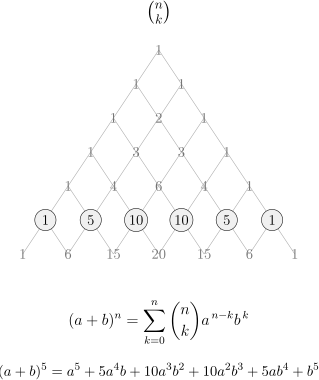
• Wanneer we enkel de binomiaalcoëfficiënten opschrijven, vinden we nog een aantal bijzonderheden.
| . |
|---|
| \((x+a)^n\) |
binomiaalcoëfficiënten |
| \((a+b)^0\) |
|
|
|
|
|
|
1 |
|
|
|
|
|
|
| \((a+b)^1\) |
|
|
|
|
|
1 |
|
1 |
|
|
|
|
|
| \((a+b)^2\) |
|
|
|
|
1 |
|
2 |
|
1 |
|
|
|
|
| \((a+b)^3\) |
|
|
|
1 |
|
3 |
|
3 |
|
1 |
|
|
|
| \((a+b)^4\) |
|
|
1 |
|
4 |
|
6 |
|
4 |
|
1 |
|
|
| \((a+b)^5\) |
|
1 |
|
5 |
|
10 |
|
10 |
|
5 |
|
1 |
|
Er ontstaat een driehoek, de zogeheten driehoek van Pascal. De getallen die erin voorkomen, herkennen we als mogelijke aantallen
van combinaties zonder herhaling:
\(C^0_0=1\)
\(C^0_1=1\) \(C^1_1=1\)
\(C^0_2=1\) \(C^1_2=2\) \(C^2_2=1\)
\(C^0_3=1\) \(C^1_3=3\) \(C^2_3=3\) \(C^3_3=1\)
\(C^0_4=1\) \(C^1_4=4\) \(C^2_4=6\) \(C^3_4=4\) \(C^4_4=1\)
We noemen deze getallen vanaf nu de binomiaalcoëfficiënten en we noteren
\[{n \choose p} = \dfrac {n!}{p! \cdot (n-p)!}\]
We lezen \(n\) choose \(p\). Merk op dat de positie van \(n\) en \(p\) werd gewisseld ten opzichte van de notatie bij combinaties.
II Binomium van Newton
Al deze patronen samenvattend kunnen we besluiten voor de \(n\)-de macht van een tweeterm:
\(\seteqnumber{0}{}{0}\)
\begin{align*}
(a+b)^n &= {n \choose 0} \cdot a^{n} \cdot b^{0} + {n \choose 1} \cdot a^{n-1} \cdot b^{1} + {n \choose 2} \cdot a^{n-2} \cdot b^{2} + \ldots + {n \choose n} \cdot a^{n-n} \cdot
b^{n}\\[1em] &=\sum _{k=0}^{n} {n \choose k} \cdot a^{n-k} \cdot b^{k}
\end{align*}
Voor een bewijs door volledige inductie verwijzen we naar het handboek VBTL Combinatoriek en Kansrekening p. 62.
III Driehoek van Pascal
Hiermee kunnen we een (oneindig doorlopende) tabel maken voor de binomiaalcoëfficiënten \(n \choose p\).
| . |
|---|
| \(p \rightarrow \) |
0 |
1 |
2 |
3 |
4 |
5 |
6 |
7 |
8 |
9 |
10 |
11 |
12 |
| \(\underset {\downarrow }{n}\) |
|
|
|
|
|
|
|
|
|
|
|
|
|
| 0 |
1 |
|
|
|
|
|
|
|
|
|
|
|
|
|
|
|
|
|
|
|
|
|
|
|
|
|
|
| 1 |
1 |
1 |
|
|
|
|
|
|
|
|
|
|
|
|
|
|
|
|
|
|
|
|
|
|
|
|
|
| 2 |
1 |
2 |
1 |
|
|
|
|
|
|
|
|
|
|
|
|
|
|
|
|
|
|
|
|
|
|
|
|
| 3 |
1 |
3 |
3 |
1 |
|
|
|
|
|
|
|
|
|
|
|
|
|
|
|
|
|
|
|
|
|
|
|
| 4 |
1 |
4 |
6 |
4 |
1 |
|
|
|
|
|
|
|
|
|
|
|
|
|
|
|
|
|
|
|
|
|
|
| 5 |
1 |
5 |
10 |
10 |
5 |
1 |
|
|
|
|
|
|
|
|
|
|
|
|
|
|
|
|
|
|
|
|
|
| 6 |
1 |
6 |
15 |
20 |
15 |
6 |
1 |
|
|
|
|
|
|
|
|
|
|
|
|
|
|
|
|
|
|
|
|
| 7 |
1 |
7 |
21 |
35 |
35 |
21 |
7 |
1 |
|
|
|
|
|
|
|
|
|
|
|
|
|
|
|
|
|
|
|
| 8 |
1 |
8 |
28 |
56 |
70 |
56 |
28 |
8 |
1 |
|
|
|
|
|
|
|
|
|
|
|
|
|
|
|
|
|
|
| 9 |
1 |
9 |
36 |
84 |
126 |
126 |
84 |
36 |
9 |
1 |
|
|
|
|
|
|
|
|
|
|
|
|
|
|
|
|
|
| 10 |
1 |
10 |
45 |
120 |
210 |
252 |
210 |
120 |
45 |
10 |
1 |
|
|
|
|
|
|
|
|
|
|
|
|
|
|
|
|
| 11 |
1 |
11 |
55 |
165 |
330 |
462 |
462 |
330 |
165 |
55 |
11 |
1 |
|
|
|
|
|
|
|
|
|
|
|
|
|
|
|
| 12 |
1 |
12 |
66 |
220 |
495 |
792 |
924 |
792 |
495 |
220 |
66 |
12 |
1 |
IV Eigenschappen van de binomiaalcoëfficiënten
Concentreren we ons nog even op de driehoek van Pascal. Dan herkennen we ook daarin bepaalde patronen en symmetrieën.
Duid deze in twee verschillende kleuren aan op de voorgaande pagina.
1 Eigenschap 1
\(\displaystyle {n \choose p} = { n \choose n-p}\)
Bewijs:
\(\seteqnumber{0}{}{0}\)
\begin{align*}
\Leftrightarrow \quad \frac {n!}{p!(n-p)!} &= \frac {n!}{(n-p)!\bigl (n-(n-p)\bigr )!} \\ \Leftrightarrow \quad \frac {n!}{p!(n-p)!} &= \frac {n!}{(n-p)!\,p!}
\end{align*}
2 Eigenschap 2
\(\displaystyle {n \choose p} = {n-1 \choose p-1} + {n-1 \choose p}\)
Bewijs:
\(\seteqnumber{0}{}{0}\)
\begin{align*}
\text {RL} &= \frac {(n-1)!}{(p-1)!(n-p)!} + \frac {(n-1)!}{p!(n-1-p)!} \\ &= \frac {(n-1)!\,p}{p!(n-p)!} + \frac {(n-1)!\,(n-p)}{p!(n-p)!} \\ &= \frac
{(n-1)!\,[\,p+(n-p)\,]}{p!(n-p)!} \\ &= \frac {(n-1)!\,n}{p!(n-p)!} \\ &= \frac {n!}{p!(n-p)!} = {n \choose p} = \text {LL}.
\end{align*}
3 Oefeningen
Zie handboek VBTL Combinatoriek en Kansrekening
Nrs. 1, 2 en 3 p. 67
V Toepassingen
1 Toepassing 1: Berekeningen in een aantal decimalen nauwkeurig
Voorbeeld 1
Bereken (zonder ICT) \(1.02^{10}\) in vijf decimalen nauwkeurig.
\(\seteqnumber{0}{}{0}\)
\begin{align*}
1.02^{10} &= (1+0.02)^{10} \\ &= (1+2\cdot 10^{-2})^{10} \\ &= {10 \choose 0}(2\cdot 10^{-2})^{0} + {10 \choose 1}(2\cdot 10^{-2})^{1} + {10 \choose 2}(2\cdot 10^{-2})^{2} + \cdots
+ {10 \choose 10}(2\cdot 10^{-2})^{10} \\ &= 1 + 20\cdot 10^{-2} + 180\cdot 10^{-4} + 960\cdot 10^{-6} + 3360\cdot 10^{-8} + 8064\cdot 10^{-10} + \underbrace {\cdots }_{\substack {\text
{geen invloed meer op} \\ \text {de eerste 5 decimalen}}} \\ &\approx {\begin{aligned}[t] & 1 \\ & 0.2 \\ & 0.018 \\ & 0.00096 \\ & 0.0000336 \\ & \underline
{0.0000008064} \end {aligned}}\\ &\approx 1.2189944064
\end{align*}
In vijf decimalen nauwkeurig is \(1.02^{10} = 1.21899\).
Voorbeeld 2
Zie handboek VBTL Combinatoriek en Kansrekening p. 65: \(1.05^6\) in vier decimalen nauwkeurig.
Oefeningen
Zie handboek VBTL Combinatoriek en Kansrekening
Nr. 6 p. 68.
2 Toepassing 2: Bepaal de gevraagde term
Voorbeeld 1
Bepaal de term in \(x\) in de ontwikkeling van \((\sqrt [3]{x}-\frac {3}{x})^{11}\)
\(\seteqnumber{0}{}{0}\)
\begin{align*}
\text {alg. term} &= C_{11}^{k}\,(\sqrt [3]{x})^{11-k}\left (\frac {-3}{x}\right )^{k} \\ &= C_{11}^{k}\,(-3)^{k}\,x^{\frac {11-k}{3}}\;x^{-k} \\ &= C_{11}^{k}\,(-3)^{k}\,x^{\frac
{11-4k}{3}} \qquad \bigl (k\in \{0,1,2,\dots ,11\}\bigr )\\[1cm] \text {term in }x^{1} \Leftrightarrow \quad 1&=\frac {11-4k}{3} \\ \Leftrightarrow \quad 3&=11-4k \\ \Leftrightarrow
\;\; 4k&=8 \\ \Leftrightarrow \quad k&=2\\[1cm] \Rightarrow \ \text {gezochte term} &= C_{11}^{2}\,(-3)^{2}\,x^{1} \\ &= 55\cdot 9 \cdot x \\ &= 495x
\end{align*}
Voorbeeld 2
Zie handboek VBTL Combinatoriek en Kansrekening p. 65: Bepaal de term in \(x^5\) in de ontwikkeling van \((\sqrt
{x}-\frac {1}{x})^{8}\)
Oefeningen
Zie handboek VBTL Combinatoriek en Kansrekening Nrs. 4, 5 en 9 p. 67 en volgende.